Q: I am tired of being susceptible to the things of this world I just wish
to connect spiritually with God. I'm a sinner (a Christian with bad
habits) and wish to just live peacefully even with the struggles I am
facing as a student.
A: Thank you for your question. I appreciate your honesty about being tired of your susceptibility to fall victim to the things of this world. To be honest with you, you are no different than me or any other person. Christians have "bad habits" and struggle with sins just like everybody else. Sometimes we are taught that since we have put faith in Jesus Christ that our lives will automatically get better. That is a myth that deceives many people. That is not to say that we cannot experience victory over our bad habits and sins, but we will never completely escape them while we are in these fallen bodies. However, be encouraged by the fact that you can still "connect" with God in the midst of your struggles. It is not the absence of our struggles that leads to our connection with God, but we connect with Him in the midst of our struggles. The apostle Paul struggled with something he called a "thorn in his flesh." He prayed for the Lord to take it away from him. The response that the Lord gave to Paul was quite interesting. "But he said to me, “My grace is sufficient for you, for my power is made perfect in weakness.” Therefore I will boast all the more gladly about my weaknesses, so that Christ’s power may rest on me (2 Corinthians 12:9)." Would you agree that as Christians our purpose here in this world is to glorify God? One of the major ways that this is accomplished is by how we deal with our struggles.
Often times when we are suffering our entire focus is on God because we realize just how incapable we are of overcoming our struggles. "But he gives us more grace. That is why Scripture says: “God opposes the proud but gives grace to the humble (James 4:6).” Your acknowledgment that you are tired of being susceptible to the things of this world is a sign of your humility. It shows that you realize that you cannot overcome the things of this world in your own strength. Therefore, you are turning to the Lord for help and guidance. That is where the grace of God is made most apparent to you. It drives you to the Lord to find out why you are struggling like you are and how His grace can guide you. The danger of believing that we have found a way to overcome sin is that we can become proud. The focus is on ourselves and what we believe we are doing for God or what we believe we have done without Him. That is what the verse from James is referring to. Pride is the opposite of unconditional love. Pride says things like "Look how I overcame the sin in my life." However, humility says, "Look how Jesus Christ died for my sins." The fact that you are seeking an answer for your question is a sign of your humility and focus on the Lord and not yourself. Furthermore, you are actually validating your faith in Christ and the truth of the the Bible in your actions.
"You adulterous people, don’t you know that friendship with the world is
hatred toward God? Anyone who chooses to be a friend of the world
becomes an enemy of God (James 4:4)." Your hatred of the things of this world proves you are not a friend of the world nor are you an enemy of God. Rejoice in that. The key to beginning to see victory over the sins or bad habits you struggle with is actually contained in your question. You referred to yourself as a "Christian with bad habits." You must begin to see yourself the way God sees you. Because of your faith in Jesus Christ, God sees Him when He looks at you. Therefore, you should get to know exactly who you are in Christ. You are a brand new creation (2 Corinthians 5:17). You are totally forgiven of all your sins; past, present and future (Colossians 1:13-14). You are totally righteous (Romans 3:21-22). You are reconciled (Romans 5:10-11). You are redeemed (Galatians 4:4-5). You are sanctified (holy) (Colossians 1:22). You are justified (Romans 5:18). You are a part of the body of Christ (1 Corinthians 12:27). You are a citizen of Heaven (Philippians 3:20). You have eternal life (1 John 5:11-13). You are totally loved (Ephesians 3:17-19). How does knowing all that make you feel? God sees you like this regardless of your behavior. That is not to justify falling into sin or to encourage you to sin, but to remind you that you are not separated from God because of it. You are a Christian whether or not you have bad habits or good habits.
Many Christians have been taught that the goal of the Christian life is to stop sinning. However, that is dedicating yourself to an impossible life because you will never stop sinning. Besides, the only way to begin to live in such a way is to put yourself under some sort of law; God's law or man's law. That will only lead you to stirring up more sin in your life. "The sting of death is sin, and the power of sin is the law (1 Corinthians 15:56)." The only result from this lifestyle is that you will feel that God is disgusted with you or, as you mentioned, you will feel disconnected from Him. What you should realize is that the goal of the Christian life is to start trusting God. Remember your identity. Remember who you are in Christ. Your sins are not separating you from God. And because our sins are not separating us from Him, we are able to "approach the throne of grace with confidence, so that we may receive mercy and find grace to help us in our time of need (Hebrews 4:16)."You are connected to God because He indwells you and the one thing that could prevent Him from leaving you, your sin, has been taken away for eternity because of the death of Jesus Christ. Being free to approach God allows you to discover why you were not trusting Him when you sinned. As you begin to realize how much He loves you, you will begin to trust Him more. And when you are trusting Him you will begin to see a diminishing of the sin in your life. Why? Because you will begin to love others with the love He has for you . When you are loving others, you are not looking for opportunities to sin because you realize that what you have from God cannot be matched by what the world offers. Grace and Peace to you.
Showing posts with label Most Read. Show all posts
Showing posts with label Most Read. Show all posts
Saturday, February 11, 2012


Thursday, January 26, 2012
Sexual Healing
Q: We are not to take God's grace as an occasion to sin as Christians....I
don't even want to sin once for what He did for me, but isn't anytime we
go ahead and sin knowing we are giving in using His grace as an
occasion to sin no matter how repentant we may be afterwards?
Like tonight, I am really down and feel like I am going to sin on the
computer....I am struggling not to as evidenced by being on your site
and asking questions, but I still feel like I am going to...am I using
His grace as a means to sin?
By the way, I despise this sin of looking at sexual fetishes and
perversions.
A: Thank you for your question. As a single man myself, I understand the struggle you are going through and commend you for the strength you are displaying by trying to find help and answers. My prayer is that God can use what I am about to say to bring you some comfort and healing. Let me begin by saying that you are not guilty of using God's grace as a license to sin. The mere fact that you admit you do not want to sin and that you are seeking help for the sin you are trapped in, is proof that you are not abusing the grace of God. If there is one thing that I want you to take away from our interaction is this: God is not counting your sins against you. 2 Corinthians 5:19 clearly states "that God was reconciling the world to himself in Christ, not counting men’s sins against them." All your sins were taken away for eternity when Jesus died on the cross. While some may take this as a license to sin, the reason God did this was so that you can approach Him in confidence in order to get to know Him and begin to have a relationship with Him. And let me go one step further by saying that the real license to sin is found in teachings that say that all we have to do is answer an altar call, go into a confession booth, keep short accounts, repeat the so-called "Lord's Prayer," pray to dead saints to intercede on our behalf and so on. It is these practices that, in all honesty, are not taking sin seriously.
How many times have you tried to repent of your sins only to fall back into them? When you do this, what did you feel like? Let me guess, you felt or were made to feel that God was ashamed of you. Did you feel that God was sitting up in Heaven afraid to talk about you because you were an embarrassment? If you have ever felt that way, I am here to say that is not true. Hebrews 2:11 states, "Both the one who makes men holy and those who are made holy are of the same family. So Jesus is not ashamed to call them brothers." Jesus is not ashamed to call you His brother because His sacrifice on the cross took away your sins and His indwelling life has made you alive to God. When God looks at you He is proud to call you His beloved son. Do not believe for one instant the lies that tell you otherwise. Too often Christians are taught that God holds their sins against them. Therefore, we deceive ourselves into believing that God is not only ashamed of us, but that our sins separate us from Him, that He will hide His face from us or that He turns His back on us until we repent or perform some sacrifice like those previously mentioned. However, the Bible tells a different story.
Sin is so bad that it deserves the death of God! Yes, God had to die for our sins. We not only do not have a life to give as payment for our sins, God would not even accept it as sufficient. That is why He died in our place out of His love for us. Hebrews 10:17-18 says, "Their sins and lawless acts I will remember no more. And where these have been forgiven, there is no longer any sacrifice for sin." God no longer remembers our sins and there is no sacrifice remaining for our sins. Therefore, all the sacrifices we engage in to try and get forgiveness and all the promises we make that we will get better next time are worthless. You do not need to ask God to forgive sins He has already forgiven. It is not an act of faith to continue to do so. That brings us to an even more important question: If God is not counting our sins against us, what do we do when we sin? First of all, we weren't really doing anything beforehand when we sinned. Secondly, what you do is live in thankfulness. Instead of apologizing to God, performing a sacrifice He will not accept and then dedicating yourself to ever-changing rules and techniques to try and avoid sin, you simply say, "Thank you." Thank you because you realize that your sins deserve death and that Jesus took the penalty you deserve. Then you, as Hebrews 4:16 states, "approach the throne of grace with confidence, so that we may receive mercy and find grace to help us in our time of need." Your focus shifts from you and your behavior to His grace and mercy. You go from trying to stop sinning to discovering why you weren't trusting God when you sinned.
God loves you perfectly. When He sees you He sees the sinless perfection of Jesus Christ. We all need to look at ourselves from God's perspective. In 1 Corinthians 6, the topic of sexual immorality is addressed. After giving a description of the sins that are practiced by unbelievers, the scripture then defines what we are as Christians. In 1 Corinthians 6:11, it says, "And that is what some of you were. But you were washed, you were sanctified, you were justified in the name of the Lord Jesus Christ and by the Spirit of our God." In God's eyes, what are you now through faith in Jesus Christ? You are washed; cleansed of all your sin. You are sanctified; holy and blameless in the eyes of God. You are justified; you have the righteousness of Jesus Christ. That is your identity. John 1:12 says, "Yet to all who received him, to those who believed in his name, he gave the right to become children of God." You are a child of God because of your faith in Jesus Christ. When God looks at you He does not refer to you as that guy who cannot overcome his sexual sin. He says there goes my child who I want to help overcome that which I have taken away. We all know that sin is wrong and it is never acceptable. But, we are never told how to overcome the sin in our lives. There is only one way to begin to see a decrease in the sin in your life. That is to get your eyes off of it and on to Jesus.
Rather than looking at your sin and saying it's wrong, I need to try and stop, ask yourself why am I committing this sin? There could be many reasons you are engaging in the sin; you are seeking relief from a stressful life, you are tired of the burdens placed on you by work or church or fill in the blank. Regardless, the one thing that I believe will help you begin to see your reliance on that sin diminish is to know who you are in Christ. I have already tried to establish the fact that you are a forgiven, holy and righteous, child of the living God. But, you are also unconditionally loved (Romans 8:38-39) and totally accepted by God (Romans 15:7). How many sins do we commit in an effort to be loved or accepted by others? Yet, we only discover that the love and acceptance of others is conditional, can only be received through the commission of sin in many instances and it does not meet the deepest desires of our heart. Remember, God made you to have the needs and desires you have. However, He made you in such a way that only He can fulfill those needs through His indwelling life. You have the life of God, in the Person of the Holy Spirit, indwelling you for eternity. There is no sin that can cause His life to leave. I encourage you to do a study on your identity in Christ in order to see for yourself how God sees you. Trust Him to guide you into a deeper knowledge of who He is, how much He loves you and who you are in Him. I know from my own experience that as you encounter more of His love, the pull of those sins will begin to go away. It is the difference between trying to stop sinning and learning to trust and depend on your God and His love for you.
May God continue to reveal to you all that you have already been given through faith in Jesus Christ. Grace and Peace.
A: Thank you for your question. As a single man myself, I understand the struggle you are going through and commend you for the strength you are displaying by trying to find help and answers. My prayer is that God can use what I am about to say to bring you some comfort and healing. Let me begin by saying that you are not guilty of using God's grace as a license to sin. The mere fact that you admit you do not want to sin and that you are seeking help for the sin you are trapped in, is proof that you are not abusing the grace of God. If there is one thing that I want you to take away from our interaction is this: God is not counting your sins against you. 2 Corinthians 5:19 clearly states "that God was reconciling the world to himself in Christ, not counting men’s sins against them." All your sins were taken away for eternity when Jesus died on the cross. While some may take this as a license to sin, the reason God did this was so that you can approach Him in confidence in order to get to know Him and begin to have a relationship with Him. And let me go one step further by saying that the real license to sin is found in teachings that say that all we have to do is answer an altar call, go into a confession booth, keep short accounts, repeat the so-called "Lord's Prayer," pray to dead saints to intercede on our behalf and so on. It is these practices that, in all honesty, are not taking sin seriously.
How many times have you tried to repent of your sins only to fall back into them? When you do this, what did you feel like? Let me guess, you felt or were made to feel that God was ashamed of you. Did you feel that God was sitting up in Heaven afraid to talk about you because you were an embarrassment? If you have ever felt that way, I am here to say that is not true. Hebrews 2:11 states, "Both the one who makes men holy and those who are made holy are of the same family. So Jesus is not ashamed to call them brothers." Jesus is not ashamed to call you His brother because His sacrifice on the cross took away your sins and His indwelling life has made you alive to God. When God looks at you He is proud to call you His beloved son. Do not believe for one instant the lies that tell you otherwise. Too often Christians are taught that God holds their sins against them. Therefore, we deceive ourselves into believing that God is not only ashamed of us, but that our sins separate us from Him, that He will hide His face from us or that He turns His back on us until we repent or perform some sacrifice like those previously mentioned. However, the Bible tells a different story.
Sin is so bad that it deserves the death of God! Yes, God had to die for our sins. We not only do not have a life to give as payment for our sins, God would not even accept it as sufficient. That is why He died in our place out of His love for us. Hebrews 10:17-18 says, "Their sins and lawless acts I will remember no more. And where these have been forgiven, there is no longer any sacrifice for sin." God no longer remembers our sins and there is no sacrifice remaining for our sins. Therefore, all the sacrifices we engage in to try and get forgiveness and all the promises we make that we will get better next time are worthless. You do not need to ask God to forgive sins He has already forgiven. It is not an act of faith to continue to do so. That brings us to an even more important question: If God is not counting our sins against us, what do we do when we sin? First of all, we weren't really doing anything beforehand when we sinned. Secondly, what you do is live in thankfulness. Instead of apologizing to God, performing a sacrifice He will not accept and then dedicating yourself to ever-changing rules and techniques to try and avoid sin, you simply say, "Thank you." Thank you because you realize that your sins deserve death and that Jesus took the penalty you deserve. Then you, as Hebrews 4:16 states, "approach the throne of grace with confidence, so that we may receive mercy and find grace to help us in our time of need." Your focus shifts from you and your behavior to His grace and mercy. You go from trying to stop sinning to discovering why you weren't trusting God when you sinned.
God loves you perfectly. When He sees you He sees the sinless perfection of Jesus Christ. We all need to look at ourselves from God's perspective. In 1 Corinthians 6, the topic of sexual immorality is addressed. After giving a description of the sins that are practiced by unbelievers, the scripture then defines what we are as Christians. In 1 Corinthians 6:11, it says, "And that is what some of you were. But you were washed, you were sanctified, you were justified in the name of the Lord Jesus Christ and by the Spirit of our God." In God's eyes, what are you now through faith in Jesus Christ? You are washed; cleansed of all your sin. You are sanctified; holy and blameless in the eyes of God. You are justified; you have the righteousness of Jesus Christ. That is your identity. John 1:12 says, "Yet to all who received him, to those who believed in his name, he gave the right to become children of God." You are a child of God because of your faith in Jesus Christ. When God looks at you He does not refer to you as that guy who cannot overcome his sexual sin. He says there goes my child who I want to help overcome that which I have taken away. We all know that sin is wrong and it is never acceptable. But, we are never told how to overcome the sin in our lives. There is only one way to begin to see a decrease in the sin in your life. That is to get your eyes off of it and on to Jesus.
Rather than looking at your sin and saying it's wrong, I need to try and stop, ask yourself why am I committing this sin? There could be many reasons you are engaging in the sin; you are seeking relief from a stressful life, you are tired of the burdens placed on you by work or church or fill in the blank. Regardless, the one thing that I believe will help you begin to see your reliance on that sin diminish is to know who you are in Christ. I have already tried to establish the fact that you are a forgiven, holy and righteous, child of the living God. But, you are also unconditionally loved (Romans 8:38-39) and totally accepted by God (Romans 15:7). How many sins do we commit in an effort to be loved or accepted by others? Yet, we only discover that the love and acceptance of others is conditional, can only be received through the commission of sin in many instances and it does not meet the deepest desires of our heart. Remember, God made you to have the needs and desires you have. However, He made you in such a way that only He can fulfill those needs through His indwelling life. You have the life of God, in the Person of the Holy Spirit, indwelling you for eternity. There is no sin that can cause His life to leave. I encourage you to do a study on your identity in Christ in order to see for yourself how God sees you. Trust Him to guide you into a deeper knowledge of who He is, how much He loves you and who you are in Him. I know from my own experience that as you encounter more of His love, the pull of those sins will begin to go away. It is the difference between trying to stop sinning and learning to trust and depend on your God and His love for you.
May God continue to reveal to you all that you have already been given through faith in Jesus Christ. Grace and Peace.
Saturday, January 14, 2012
Religion: From man or God?
"Then he took the Book of the Covenant and read it to the people. They responded, “We will do everything the LORD has said; we will obey.” Exodus 24:7
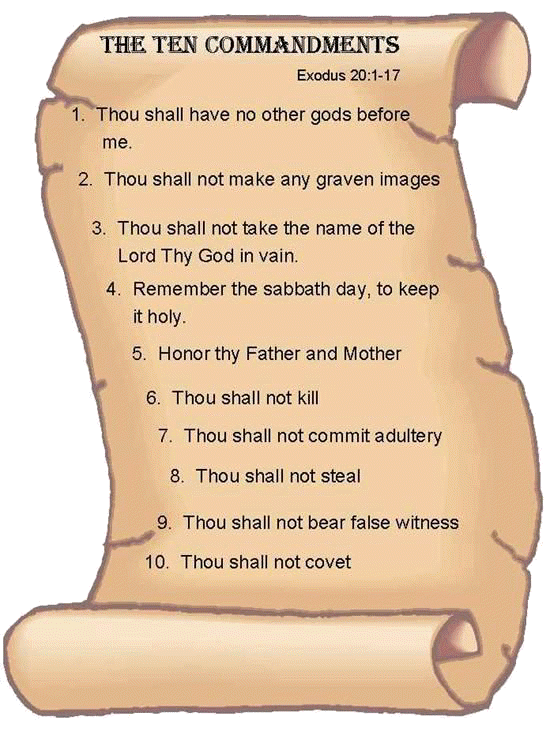
 Religion is often said to be man-made. It has been described as "man's best effort to reach up to God." Now, I agree with this definition. However, I do not agree, or should I say I no longer agree, that religion is man-made. Exodus 20:1, starts out by saying, "And God spoke all these words.." The Lord then proceeds to deliver the Ten Commandments to Moses. The Ten Commandments have gone on to become the foundation of nearly every Christian religion, not just the religion of Judaism. In fact, one Christian author said this regarding the Ten Commandments: "Take them to heart and learn them so that they are implanted in the mind and available for guidance." They have also become the building blocks of much of civilized society, including the United States of America. Noah Webster, who helped author the U.S. Constitution, wrote, "The duties of men are summarily compromised in the Ten Commandments, consisting of two tables; one comprehending the duties which we owe immediately to God-the other, the duties we owe to our fellow men." Therefore, the long-reaching affect of the Ten Commandments has spanned thousands of years touching every walk of life from the spiritual to the political realm. And it all started when God spoke.
However, while we see that God was the one who gave the foundation for what we call religion, and not man, His main purpose for giving it was not for men to have a religious lifestyle or for it to be the building blocks of society. As one pastor said, "The Law was God's contribution to man's best effort to be like Him." In other words, the reason God gave the Ten Commandments, and the rest of the Law, was in response to the Fall of Man. God, through His Commandments, is basically telling mankind, "If you want to be like Me, here is what you must do." Why do I say such a thing? When Adam and Eve were deceived by Satan in the Garden of Eden, Satan said to Eve, "For God knows that when you eat of it your eyes will be opened, and you will be like God, knowing good and evil (Genesis 3:5).” What is Law if not God telling us what He sees as good and evil? Since mankind decided not to believe God and listen to the lie of Satan, God has listed His requirements for what it will take to be like Him. Unfortunately, still deceived by Satan, mankind has taken God's Commandments and tried to be like Him through endless attempts at obedience to them rather than realize that we can never live up to His Commandments. There is no greater example of this then the words of Jesus Christ.
In the midst of giving His Sermon on the Mount, Jesus told His audience what they must do. "Be perfect, therefore, as your heavenly Father is perfect (Matthew 5:48)." If you want be like God through obedience to the Ten Commandments or religious law, you must be as perfect as God! This means that from the day you are born until the day you die you must follow His Commandments perfectly. You must never have any other gods before Him. Good luck defining "gods." Never have a carved image. So much for wearing religious jewelry of any kind. Never take God's name in vain. That means if you say He is your God and commit to living under His commandments, you must obey them perfectly. Keep the Sabbath Day holy. From three stars visible on Friday night to three stars visible on Saturday night, you cannot do anything at all. Complete rest and inactivity. How are you doing on that? Honor your father and mother. Have you always been honest, fair and showed a high level of integrity with your parents in every situation? Be honest. Do not murder. Now, you may not have murdered anybody, but Jesus, God in the flesh, equated anger with murder (Matthew 5:22). Have you ever been angry with someone? Do not commit adultery. Again, you may never have committed adultery, but Jesus said that looking at a woman with lust in your heart is the same thing (Matthew 5:28). I guess there are no men in heaven. Do not steal. How many of us as children just grabbed things that were not ours? Do not bear false witness against your neighbor. Have you ever lied? Do not covet. Have you ever wanted something that was not yours? If you obeyed all of these perfectly, then you can turn your attention to the other 603 Commandments God gave the Jewish Nation. Yes, there are more than just the first ten.
After Jesus had given yet one more example of how impossible it is to get into Heaven based on our own efforts, the disciples asked each other, "Who then can be saved (Mark 10:26)?” That is the whole point of God giving the Ten Commandments and the entirety of His Law. It was not given to be the foundation of religion, but to show us our need for His grace and mercy. The apostle Paul magnifies this point in his letter to the Galatians. In Galatians 3:19, Paul asks, "What, then, was the purpose of the law?" A few verses later he gives us the answer. "So the law was put in charge to lead us to Christ that we might be justified by faith (Galatians 3:24)." God gave His Law to show us that we could not be like Him no matter how hard we tried. It was to show us that the only way to enter His Kingdom was by faith alone in Jesus Christ. God is the only one that can be obedient to His Law. The Law demands obedience or death. Jesus took both options for us. He lived in perfect obedience to the Law because we could not and then He died the death we deserved for our disobedience. "Now that faith has come, we are no longer under the supervision of the law (Galatians 3:25)."If you have come to faith in Jesus Christ, the Ten Commandments, the entire Law of God, and the religion that comes from it, have no place in your life. Now you live by faith in the indwelling Holy Spirit of God to guide you and lead you from within as you respond to the love of God that meets the desires of your heart.
However, while we see that God was the one who gave the foundation for what we call religion, and not man, His main purpose for giving it was not for men to have a religious lifestyle or for it to be the building blocks of society. As one pastor said, "The Law was God's contribution to man's best effort to be like Him." In other words, the reason God gave the Ten Commandments, and the rest of the Law, was in response to the Fall of Man. God, through His Commandments, is basically telling mankind, "If you want to be like Me, here is what you must do." Why do I say such a thing? When Adam and Eve were deceived by Satan in the Garden of Eden, Satan said to Eve, "For God knows that when you eat of it your eyes will be opened, and you will be like God, knowing good and evil (Genesis 3:5).” What is Law if not God telling us what He sees as good and evil? Since mankind decided not to believe God and listen to the lie of Satan, God has listed His requirements for what it will take to be like Him. Unfortunately, still deceived by Satan, mankind has taken God's Commandments and tried to be like Him through endless attempts at obedience to them rather than realize that we can never live up to His Commandments. There is no greater example of this then the words of Jesus Christ.
In the midst of giving His Sermon on the Mount, Jesus told His audience what they must do. "Be perfect, therefore, as your heavenly Father is perfect (Matthew 5:48)." If you want be like God through obedience to the Ten Commandments or religious law, you must be as perfect as God! This means that from the day you are born until the day you die you must follow His Commandments perfectly. You must never have any other gods before Him. Good luck defining "gods." Never have a carved image. So much for wearing religious jewelry of any kind. Never take God's name in vain. That means if you say He is your God and commit to living under His commandments, you must obey them perfectly. Keep the Sabbath Day holy. From three stars visible on Friday night to three stars visible on Saturday night, you cannot do anything at all. Complete rest and inactivity. How are you doing on that? Honor your father and mother. Have you always been honest, fair and showed a high level of integrity with your parents in every situation? Be honest. Do not murder. Now, you may not have murdered anybody, but Jesus, God in the flesh, equated anger with murder (Matthew 5:22). Have you ever been angry with someone? Do not commit adultery. Again, you may never have committed adultery, but Jesus said that looking at a woman with lust in your heart is the same thing (Matthew 5:28). I guess there are no men in heaven. Do not steal. How many of us as children just grabbed things that were not ours? Do not bear false witness against your neighbor. Have you ever lied? Do not covet. Have you ever wanted something that was not yours? If you obeyed all of these perfectly, then you can turn your attention to the other 603 Commandments God gave the Jewish Nation. Yes, there are more than just the first ten.
After Jesus had given yet one more example of how impossible it is to get into Heaven based on our own efforts, the disciples asked each other, "Who then can be saved (Mark 10:26)?” That is the whole point of God giving the Ten Commandments and the entirety of His Law. It was not given to be the foundation of religion, but to show us our need for His grace and mercy. The apostle Paul magnifies this point in his letter to the Galatians. In Galatians 3:19, Paul asks, "What, then, was the purpose of the law?" A few verses later he gives us the answer. "So the law was put in charge to lead us to Christ that we might be justified by faith (Galatians 3:24)." God gave His Law to show us that we could not be like Him no matter how hard we tried. It was to show us that the only way to enter His Kingdom was by faith alone in Jesus Christ. God is the only one that can be obedient to His Law. The Law demands obedience or death. Jesus took both options for us. He lived in perfect obedience to the Law because we could not and then He died the death we deserved for our disobedience. "Now that faith has come, we are no longer under the supervision of the law (Galatians 3:25)."If you have come to faith in Jesus Christ, the Ten Commandments, the entire Law of God, and the religion that comes from it, have no place in your life. Now you live by faith in the indwelling Holy Spirit of God to guide you and lead you from within as you respond to the love of God that meets the desires of your heart.
Tuesday, October 11, 2011
Consciousness and the Brain
Q: Is consciousness separate from the brain/mind? I would assume so. I consider the brain/mind simply flesh like all other parts that will return to dust when we die. I realize we have the 'mind of christ' but that mind is not our soul, and that mind won't live forever. We will have been transformed at the resurrection, right? The mind is separate from the soul right? I suppose I am really confused. In Genesis, it talks about how God breathed the breath of life into us and we became a living soul. A living soul (consciousness) inside a body (with a mind) that is only sustained by the breath of God (spirit), that's what I take from it. Please let me know if I am incorrect in my thinking that consciousness is separate from the mind/body, and please help me sort this out. I know I have a lot of questions but they are important to me. Thanks, God bless.
A: Thank you for your questions. No doubt your questions have been investigated since as long as we can remember. I do not presume to say that my answers are going to settle the matter, but, hopefully, they will guide you towards the answers you seek.
Is consciousness separate from the brain/mind? Consciousness is defined as "the state of being conscious; knowledge of one's own existence, condition, sensations, mental operations, acts, etc." The mind is defined as "The intellectual or rational faculty in man; the understanding; the intellect; the power that conceives, judges, or reasons; also, the entire spiritual nature; the soul; -- often in distinction from the body." If we accept these two defintions then it would seem that there is a distinction between consciousness and the brain/mind. In a nutshell, consciousness is being aware while the mind is the home of emotion and will. Perhaps, we can say that the mind is our consciousness in action. Biblically, there are not many uses of the word consciousness, but mind, given its varying definitions is used numerous times. Hebrews 10:2 talks about "consciousness of sins" as it pertains to being aware of sins. The word "mind" is used 114 times in the NIV Translation alone. Most usages of the word pertain to an action being undertaken as in "Bear in mind (Exodus 16:29), "call to mind (Lamentations 3:21)" and "men of corrupt mind (1 Timothy 6:5)."
We will have been transformed at the resurrection, right? Yes, Christians will be transformed at the resurrection. How that will affect our mind and brain is not completely known. But, since the brain is flesh and blood, it would stand to reason that it will be transformed as part of our new spiritual bodies. And of course, we will also have consciousness at that time as well. The Bible talks about us being absent from the body and present with the Lord (2 Corinthians 5:8). Paul desired to depart and be with Jesus Christ (Philippians 1:23). The story of the Rich Man and Lazarus indicates a conscious existence in the afterlife (Luke 16:19-31). There are souls under God's altar (Revelation 6:9). And the thief on the cross was promised that "today" he would be with Christ in Paradise (Luke 23:43).
The mind is separate from the soul, right? Not necessarily. I believe the mind is a part the soul. The soul is defined as "The spiritual, rational, and immortal part in man; that part of man which enables him to think, and which renders him a subject of moral government." In more common terms, the soul can be described as the "mind, emotion and will" of an individual. While it can be argued that all living creatures have a mind, emotion and will, it is the spiritual component of mankind that separates us from the rest of God's creatures. It is that spiritual component to our souls that leads us to ask questions like, "Who am I? Why am I here? Where am I going?" And this leads directly into your concluding statement.
In Genesis, it talks about how God breathed the breath of life into us and we became a living soul. A living soul (consciousness) inside a body (with a mind) that is only sustained by the breath of God (spirit), that's what I take from it. Whether you realize it or not, you have stumbled upon the foundation of the Gospel message. I think what you say here is on the right track. We are all conscious whether or not we have the the life of God (breath of life) in us. Look at it from a different perspective. The passage you reference is Genesis 2:7, where God breathed His life into Adam and he became a living being. However, God also warned Adam that he would die if he ate the forbidden fruit (Genesis 2:17). Adam did eat the forbidden fruit and he died spiritually (Genesis 3:6). That life breathed into Him was removed by God. Adam was alive physically, but spiritually dead to God. That is the problem between man and God. We are all born into the world spiritually dead and in need of the life of God to indwell us. That is where Jesus Christ comes into the picture. Before God could offer His life to us again, He had to deal with the sin that caused Him to remove His life. Jesus, God in the flesh (Matthew 1:23), was the only man born with a life to give that would satisfy God as payment for our sins (1 John 2:2). Now, raised from the dead, Jesus can now offer the life of God, as a free gift, to all who accept Him by faith (Romans 6:23). And because of the death of Jesus Christ, there is now no sin that will cause the life of God to ever leave a Christian. Thus, the life we have is an eternal life.
From God's vantage point, the problem man faces is not just that he is a sinner in need of forgiveness, but that he is dead and in need of life. It is that consciousness we all have that makes us aware that something is missing. That something missing is the life of God, His indwelling Holy Spirit, that is only available through faith in Jesus Christ. Our brains/minds are what helps us process the evidence God has provided to us so we can investigate His truths and make a choice as whether or not to accept Jesus Christ by faith. My prayer is that this shed some light on the subject for you. Grace and Peace.
A: Thank you for your questions. No doubt your questions have been investigated since as long as we can remember. I do not presume to say that my answers are going to settle the matter, but, hopefully, they will guide you towards the answers you seek.
Is consciousness separate from the brain/mind? Consciousness is defined as "the state of being conscious; knowledge of one's own existence, condition, sensations, mental operations, acts, etc." The mind is defined as "The intellectual or rational faculty in man; the understanding; the intellect; the power that conceives, judges, or reasons; also, the entire spiritual nature; the soul; -- often in distinction from the body." If we accept these two defintions then it would seem that there is a distinction between consciousness and the brain/mind. In a nutshell, consciousness is being aware while the mind is the home of emotion and will. Perhaps, we can say that the mind is our consciousness in action. Biblically, there are not many uses of the word consciousness, but mind, given its varying definitions is used numerous times. Hebrews 10:2 talks about "consciousness of sins" as it pertains to being aware of sins. The word "mind" is used 114 times in the NIV Translation alone. Most usages of the word pertain to an action being undertaken as in "Bear in mind (Exodus 16:29), "call to mind (Lamentations 3:21)" and "men of corrupt mind (1 Timothy 6:5)."
We will have been transformed at the resurrection, right? Yes, Christians will be transformed at the resurrection. How that will affect our mind and brain is not completely known. But, since the brain is flesh and blood, it would stand to reason that it will be transformed as part of our new spiritual bodies. And of course, we will also have consciousness at that time as well. The Bible talks about us being absent from the body and present with the Lord (2 Corinthians 5:8). Paul desired to depart and be with Jesus Christ (Philippians 1:23). The story of the Rich Man and Lazarus indicates a conscious existence in the afterlife (Luke 16:19-31). There are souls under God's altar (Revelation 6:9). And the thief on the cross was promised that "today" he would be with Christ in Paradise (Luke 23:43).
The mind is separate from the soul, right? Not necessarily. I believe the mind is a part the soul. The soul is defined as "The spiritual, rational, and immortal part in man; that part of man which enables him to think, and which renders him a subject of moral government." In more common terms, the soul can be described as the "mind, emotion and will" of an individual. While it can be argued that all living creatures have a mind, emotion and will, it is the spiritual component of mankind that separates us from the rest of God's creatures. It is that spiritual component to our souls that leads us to ask questions like, "Who am I? Why am I here? Where am I going?" And this leads directly into your concluding statement.
In Genesis, it talks about how God breathed the breath of life into us and we became a living soul. A living soul (consciousness) inside a body (with a mind) that is only sustained by the breath of God (spirit), that's what I take from it. Whether you realize it or not, you have stumbled upon the foundation of the Gospel message. I think what you say here is on the right track. We are all conscious whether or not we have the the life of God (breath of life) in us. Look at it from a different perspective. The passage you reference is Genesis 2:7, where God breathed His life into Adam and he became a living being. However, God also warned Adam that he would die if he ate the forbidden fruit (Genesis 2:17). Adam did eat the forbidden fruit and he died spiritually (Genesis 3:6). That life breathed into Him was removed by God. Adam was alive physically, but spiritually dead to God. That is the problem between man and God. We are all born into the world spiritually dead and in need of the life of God to indwell us. That is where Jesus Christ comes into the picture. Before God could offer His life to us again, He had to deal with the sin that caused Him to remove His life. Jesus, God in the flesh (Matthew 1:23), was the only man born with a life to give that would satisfy God as payment for our sins (1 John 2:2). Now, raised from the dead, Jesus can now offer the life of God, as a free gift, to all who accept Him by faith (Romans 6:23). And because of the death of Jesus Christ, there is now no sin that will cause the life of God to ever leave a Christian. Thus, the life we have is an eternal life.
From God's vantage point, the problem man faces is not just that he is a sinner in need of forgiveness, but that he is dead and in need of life. It is that consciousness we all have that makes us aware that something is missing. That something missing is the life of God, His indwelling Holy Spirit, that is only available through faith in Jesus Christ. Our brains/minds are what helps us process the evidence God has provided to us so we can investigate His truths and make a choice as whether or not to accept Jesus Christ by faith. My prayer is that this shed some light on the subject for you. Grace and Peace.
Sunday, September 4, 2011
Witnessing the Transfiguration
Q: Why did Jesus pick the three disciples Peter, John and James to witness the transfiguration?
A: Thank you for your question. The Bible does not readily give an answer as to why Jesus chose Peter, John and James to accompany Him to the mountain where He was transfigured (Matthew 17:1-9, Mark 9:2-8, Luke 9:28-36). However, given what we know about Peter, John and James, we might be able to figure out a meaning for their presence at the event. To do so, let us look at each of the three individually.
Peter - Peter wrote two books of the Bible, 1 Peter and 2 Peter. Yet, what he is most remembered for is his denial of knowing Jesus Christ three times prior to the death of the Lord (Matthew 26:75). One of Peter's attributes seemed to be that he was fearful. Not only do we witness this when he denied Jesus three times, because he was fearful for his life, but we see it later on when it led to him being scolded by Paul for being a hypocrite in the presence of the men who came from James (Galatians 2:12). During the Transfiguration it is recorded that Peter said, ""Rabbi, it is good for us to be here. Let us put up three shelters—one for you, one for Moses and one for Elijah.” (He did not know what to say, they were so frightened.) (Mark 9:5-6)" Peter did not know what to say because he was frightened. In the account of the Transfiguration recorded in Matthew it says that after God spoke Peter, John and James "fell facedown to the ground, terrified (Matthew 17:6)." And then Jesus, in an attempt to comfort them, said, “Get up.. Don’t be afraid (Matthew 17:7).” Even though it is understandable why Peter would be afraid when worried about being taken by a mob, hearing the voice of God and when being around judgmental people, it is still a theme that is prevalent in his life. However, the experience at the Transfiguration made a huge impression on Peter. So much so that he wrote about it in 2 Peter 1:16-18, when defending the truth regarding Jesus Christ being God in the flesh. He did not deny Jesus this time around. He was not afraid to admit knowing Him.
John - As far as John's presence at the Transfiguration is concerned, it could have simply been an act of love towards John. On more than one occasion, depending on which Bible translation you are using, John is referred to as the "disciple whom Jesus loved (John 13:23, 19:26, 21:7, 21:20)." In one of the more memorable and intimate moments recorded in the Bible, we see how much Jesus loved John. "Near the cross of Jesus stood his mother, his mother’s sister, Mary the wife of Clopas, and Mary Magdalene. When Jesus saw his mother there, and the disciple whom he loved standing nearby, he said to his mother, “Dear woman, here is your son,” and to the disciple, “Here is your mother.” From that time on, this disciple took her into his home (John 19:25-27)." While dying on the cross, Jesus tells John to take care of Mary for Him. This is an obvious admission of the Lord's love for, and trust in, John. Although John doesn't refer directly to the Transfiguration, like Peter did in his second letter, he no doubt must have recalled that moment when writing 1 John. John wrote this letter to address the heresy of gnosticism; a teaching that falsely claimed that Jesus did not come in the flesh. Therefore, right from the beginning of his letter, John relies on his personal experiences with Jesus Christ to rebuke the error. "That which was from the beginning, which we have heard, which we have seen with our eyes, which we have looked at and our hands have touched—this we proclaim concerning the Word of life (1 John 1:1)."
James - James was the brother of the Apostle John as is referenced in the Matthew 17:1. Given the affection that the Lord had for John, it is conceivable that He shared a similar affection for his brother, James. Therefore, the Lord had no problem letting him share in the glorious event of the Transfiguration. This James is not considered to be the half-brother of Jesus who is the author of the epistle bearing the same name. In fact, this James was martyred when King Agrippa killed him (Acts 12:2). By most accounts, James was martyred in A.D. 44, whereas the epistle of James, the half-brother of Jesus, is said to have been written between A.D. 50 and A.D. 60. Given the fact that King Agrippa killed James in an attempt to persecute the church is proof that James was known for his faith. Perhaps his presence at the Transfiguration, as well as other important events like the healing of the daughter of Jairus (Mark 5:37), Jesus agonizing in Gethsemane and His subsequent arrest (Matthew 26:36-56), played a large role in his conviction to evangelize. Interesting to note is that in the account of the healing of the daughter of Jairus a reference is made to fear. After Jairus was told that his daughter had died, Jesus said to him, “Don’t be afraid; just believe (Mark 5:36).” One can only wonder if James overheard the Lord saying this to Jairus. If so, it parallels what He said to James, John and Peter at the Transfiguration when they were frightened by what they were witnessing.
Regardless of why Peter, John and James were present at the Transfiguration, we can see that an event like that can be used by God to embolden those in attendance as well as other believers who read about what transpired. Christian faith is not a blind faith. Our faith has an object, which is Jesus Christ. Knowing what He has done in the lives of fellow Christians throughout history and in our own lives encourages us to not be afraid to testify about who He is and the salvation He offers to the world. Grace and Peace.
A: Thank you for your question. The Bible does not readily give an answer as to why Jesus chose Peter, John and James to accompany Him to the mountain where He was transfigured (Matthew 17:1-9, Mark 9:2-8, Luke 9:28-36). However, given what we know about Peter, John and James, we might be able to figure out a meaning for their presence at the event. To do so, let us look at each of the three individually.
Peter - Peter wrote two books of the Bible, 1 Peter and 2 Peter. Yet, what he is most remembered for is his denial of knowing Jesus Christ three times prior to the death of the Lord (Matthew 26:75). One of Peter's attributes seemed to be that he was fearful. Not only do we witness this when he denied Jesus three times, because he was fearful for his life, but we see it later on when it led to him being scolded by Paul for being a hypocrite in the presence of the men who came from James (Galatians 2:12). During the Transfiguration it is recorded that Peter said, ""Rabbi, it is good for us to be here. Let us put up three shelters—one for you, one for Moses and one for Elijah.” (He did not know what to say, they were so frightened.) (Mark 9:5-6)" Peter did not know what to say because he was frightened. In the account of the Transfiguration recorded in Matthew it says that after God spoke Peter, John and James "fell facedown to the ground, terrified (Matthew 17:6)." And then Jesus, in an attempt to comfort them, said, “Get up.. Don’t be afraid (Matthew 17:7).” Even though it is understandable why Peter would be afraid when worried about being taken by a mob, hearing the voice of God and when being around judgmental people, it is still a theme that is prevalent in his life. However, the experience at the Transfiguration made a huge impression on Peter. So much so that he wrote about it in 2 Peter 1:16-18, when defending the truth regarding Jesus Christ being God in the flesh. He did not deny Jesus this time around. He was not afraid to admit knowing Him.
John - As far as John's presence at the Transfiguration is concerned, it could have simply been an act of love towards John. On more than one occasion, depending on which Bible translation you are using, John is referred to as the "disciple whom Jesus loved (John 13:23, 19:26, 21:7, 21:20)." In one of the more memorable and intimate moments recorded in the Bible, we see how much Jesus loved John. "Near the cross of Jesus stood his mother, his mother’s sister, Mary the wife of Clopas, and Mary Magdalene. When Jesus saw his mother there, and the disciple whom he loved standing nearby, he said to his mother, “Dear woman, here is your son,” and to the disciple, “Here is your mother.” From that time on, this disciple took her into his home (John 19:25-27)." While dying on the cross, Jesus tells John to take care of Mary for Him. This is an obvious admission of the Lord's love for, and trust in, John. Although John doesn't refer directly to the Transfiguration, like Peter did in his second letter, he no doubt must have recalled that moment when writing 1 John. John wrote this letter to address the heresy of gnosticism; a teaching that falsely claimed that Jesus did not come in the flesh. Therefore, right from the beginning of his letter, John relies on his personal experiences with Jesus Christ to rebuke the error. "That which was from the beginning, which we have heard, which we have seen with our eyes, which we have looked at and our hands have touched—this we proclaim concerning the Word of life (1 John 1:1)."
James - James was the brother of the Apostle John as is referenced in the Matthew 17:1. Given the affection that the Lord had for John, it is conceivable that He shared a similar affection for his brother, James. Therefore, the Lord had no problem letting him share in the glorious event of the Transfiguration. This James is not considered to be the half-brother of Jesus who is the author of the epistle bearing the same name. In fact, this James was martyred when King Agrippa killed him (Acts 12:2). By most accounts, James was martyred in A.D. 44, whereas the epistle of James, the half-brother of Jesus, is said to have been written between A.D. 50 and A.D. 60. Given the fact that King Agrippa killed James in an attempt to persecute the church is proof that James was known for his faith. Perhaps his presence at the Transfiguration, as well as other important events like the healing of the daughter of Jairus (Mark 5:37), Jesus agonizing in Gethsemane and His subsequent arrest (Matthew 26:36-56), played a large role in his conviction to evangelize. Interesting to note is that in the account of the healing of the daughter of Jairus a reference is made to fear. After Jairus was told that his daughter had died, Jesus said to him, “Don’t be afraid; just believe (Mark 5:36).” One can only wonder if James overheard the Lord saying this to Jairus. If so, it parallels what He said to James, John and Peter at the Transfiguration when they were frightened by what they were witnessing.
Regardless of why Peter, John and James were present at the Transfiguration, we can see that an event like that can be used by God to embolden those in attendance as well as other believers who read about what transpired. Christian faith is not a blind faith. Our faith has an object, which is Jesus Christ. Knowing what He has done in the lives of fellow Christians throughout history and in our own lives encourages us to not be afraid to testify about who He is and the salvation He offers to the world. Grace and Peace.
Saturday, July 23, 2011
Unclaimed Blessing
Q: What's a good scripture about claiming your blessing?
A: Thank you for your question. Honestly, there is no scripture that specifically talks about claiming your blessing. At least not in the context I believe you are asking. The question implies that there is a blessing that you do not have that you need to acquire. By definition, to claim means "to call for or need; deserve." If we use this definition, the question must be asked, "What blessing do you deserve that you are making a claim to?" This indicates an attitude that God owes you for your obedience to Him. Therefore, how do you measure up to God's requirements in order to receive His blessings? Jesus said, "For I tell you that unless your righteousness surpasses that of the Pharisees and the teachers of the law, you will certainly not enter the kingdom of heaven (Matthew 5:20)." How are you doing on that one? And if that is not hard enough to do, Jesus raised the bar a few verses later. He said, "Be perfect, therefore, as your heavenly Father is perfect (Matthew 5:48)." In order to receive the blessings of God, perfect obedience to His Law is required. The conclusion is that you will never live a righteous enough life in order to claim any blessings from God.
For many Christians the blessings they desire to claim are the blessings of the flesh. In order to get these desires met they will look through the Old Testament and pick and choose scriptures given to the nation of Israel and "claim" them for themselves. They will take passages like Deuteronomy 28:1-14 and verses like Jeremiah 29:11 and Malachi 3:10 and "claim" them for themselves because of the promised blessings given. Unfortunately, what they fail to realize, as was previously mentioned, is that all the blessings God promised to the nation of Israel were contingent on their obedience to His law. And what is skipped by many of these same Christians are the curses for disobedience to God's law. Ignored are passages like Deuteronomy 28:15-68, which outlines the terrible curses awaiting the disobedient, and Malachi 3:7 which talks about Jewish forefathers who "turned away from my decrees and have not kept them." If you are concerned about claiming your blessing you need to be more concerned about your inability to do what is required to be blessed. Many Christians have dedicated themselves to an impossible life under the Law in an effort to obtain from God blessings He has not promised to give them and are missing out on the blessings He has freely given to us in Christ Jesus.
Many Christians live their lives as if something is missing from it. The fact is, something is missing from their lives. What is missing from their lives is the understanding of what is God's blessing. Ephesians 1:3 states, "Praise be to the God and Father of our Lord Jesus Christ, who has blessed us in the heavenly realms with every spiritual blessing in Christ." The blessing God has freely given to all Christians, and offers to the entire world, is Himself. God, through the indwelling Holy Spirit, lives eternally within the body of every born again Christian. Here is a question for you? "Why do you want to claim your blessing?" Inherent in the question is the acknowledgement that something is missing from your life. For most of us, we believe that that void can be met through the acquisition of material and physical blessings. That is why the Old Testament promises of God, to those who obey the Law, are so appealing. We falsely believe that through the acquisition of those things the deepest desires of our heart will be met. The great thing is that God gave us those desires of our heart, but He designed us in such a way that He is the only one that can satisfy those desires.
We all have the desire for unconditional love, total acceptance, meaning and purpose to life. And because of this we deceive ourselves into believing that if our flesh is blessed in some way, these needs will be satisfied. And if we are truthful, we will have to acknowledge that this is not the case. Salvation is the restoration of the life of God that mankind lost when Adam sinned in the Garden of Eden. God, through the Resurrection of Jesus Christ, has restored His life to all those who have accepted Jesus Christ by faith. His indwelling presence meets the deepest desires of our heart because He has restored Himself to us as was His original plan. Now, in Christ, we are unconditionally loved by God (Romans 8:38-39) and are totally accepted by Him (Romans 15:7). This, in turn, gives us meaning and purpose to life because we now understand that God has created us for Himself so that, in Him, we can share that which we have received from Him with the world. This will release us from the bondage of trying to claim blessings of the flesh through our self-effort, which will never meet the needs of our heart that are only met by God through faith in Jesus Christ. Instead of trying to claim blessings you do not deserve and will not meet your needs, receive the blessing of the Spirit that you do need and that only Jesus Christ has freely given you through your faith in Him. Grace and Peace
A: Thank you for your question. Honestly, there is no scripture that specifically talks about claiming your blessing. At least not in the context I believe you are asking. The question implies that there is a blessing that you do not have that you need to acquire. By definition, to claim means "to call for or need; deserve." If we use this definition, the question must be asked, "What blessing do you deserve that you are making a claim to?" This indicates an attitude that God owes you for your obedience to Him. Therefore, how do you measure up to God's requirements in order to receive His blessings? Jesus said, "For I tell you that unless your righteousness surpasses that of the Pharisees and the teachers of the law, you will certainly not enter the kingdom of heaven (Matthew 5:20)." How are you doing on that one? And if that is not hard enough to do, Jesus raised the bar a few verses later. He said, "Be perfect, therefore, as your heavenly Father is perfect (Matthew 5:48)." In order to receive the blessings of God, perfect obedience to His Law is required. The conclusion is that you will never live a righteous enough life in order to claim any blessings from God.
For many Christians the blessings they desire to claim are the blessings of the flesh. In order to get these desires met they will look through the Old Testament and pick and choose scriptures given to the nation of Israel and "claim" them for themselves. They will take passages like Deuteronomy 28:1-14 and verses like Jeremiah 29:11 and Malachi 3:10 and "claim" them for themselves because of the promised blessings given. Unfortunately, what they fail to realize, as was previously mentioned, is that all the blessings God promised to the nation of Israel were contingent on their obedience to His law. And what is skipped by many of these same Christians are the curses for disobedience to God's law. Ignored are passages like Deuteronomy 28:15-68, which outlines the terrible curses awaiting the disobedient, and Malachi 3:7 which talks about Jewish forefathers who "turned away from my decrees and have not kept them." If you are concerned about claiming your blessing you need to be more concerned about your inability to do what is required to be blessed. Many Christians have dedicated themselves to an impossible life under the Law in an effort to obtain from God blessings He has not promised to give them and are missing out on the blessings He has freely given to us in Christ Jesus.
Many Christians live their lives as if something is missing from it. The fact is, something is missing from their lives. What is missing from their lives is the understanding of what is God's blessing. Ephesians 1:3 states, "Praise be to the God and Father of our Lord Jesus Christ, who has blessed us in the heavenly realms with every spiritual blessing in Christ." The blessing God has freely given to all Christians, and offers to the entire world, is Himself. God, through the indwelling Holy Spirit, lives eternally within the body of every born again Christian. Here is a question for you? "Why do you want to claim your blessing?" Inherent in the question is the acknowledgement that something is missing from your life. For most of us, we believe that that void can be met through the acquisition of material and physical blessings. That is why the Old Testament promises of God, to those who obey the Law, are so appealing. We falsely believe that through the acquisition of those things the deepest desires of our heart will be met. The great thing is that God gave us those desires of our heart, but He designed us in such a way that He is the only one that can satisfy those desires.
We all have the desire for unconditional love, total acceptance, meaning and purpose to life. And because of this we deceive ourselves into believing that if our flesh is blessed in some way, these needs will be satisfied. And if we are truthful, we will have to acknowledge that this is not the case. Salvation is the restoration of the life of God that mankind lost when Adam sinned in the Garden of Eden. God, through the Resurrection of Jesus Christ, has restored His life to all those who have accepted Jesus Christ by faith. His indwelling presence meets the deepest desires of our heart because He has restored Himself to us as was His original plan. Now, in Christ, we are unconditionally loved by God (Romans 8:38-39) and are totally accepted by Him (Romans 15:7). This, in turn, gives us meaning and purpose to life because we now understand that God has created us for Himself so that, in Him, we can share that which we have received from Him with the world. This will release us from the bondage of trying to claim blessings of the flesh through our self-effort, which will never meet the needs of our heart that are only met by God through faith in Jesus Christ. Instead of trying to claim blessings you do not deserve and will not meet your needs, receive the blessing of the Spirit that you do need and that only Jesus Christ has freely given you through your faith in Him. Grace and Peace
Saturday, July 9, 2011
Let the Dead bury their own dead
Q: What did Jesus mean when He said, "Let the dead bury their own dead"?
A: Thank you for your question. This response must have baffled the disciples at the time. Jesus’ response was a mixture of the spiritual and physical. In Matthew 8:21-22, we read, “Another disciple said to him, “Lord, first let me go and bury my father.” But Jesus told him, “Follow me, and let the dead bury their own dead.”” If you were to rewrite verse 22, it might say something like, “But Jesus told him, “Follow me, and let the spiritually dead bury the physically dead.”” We don’t often think about those who are alive as being dead, but in the context of the Gospel of Jesus Christ and salvation, acknowledging that fact is essential. The entire reason for Jesus Christ coming to the world was to give us life, the life of God. “The thief comes only to steal and kill and destroy; I have come that they may have life, and have it to the full (John 10:10).” Too often this verse is used to support the false belief that Jesus wants Christians living their lives to the fullest in the flesh. When, in fact, it is a salvation passage where Jesus is offering to restore the life of God, lost in Adam, to all who place saving faith in Him.
In order for this to make sense you have to know what is the problem between man and God that Jesus came to fix. In Genesis 2:7, it says, “the LORD God formed the man from the dust of the ground and breathed into his nostrils the breath of life, and the man became a living being.” God breathed His very life into Adam and Adam became alive to God. God then warned Adam that he “must not eat from the tree of the knowledge of good and evil, for when you eat of it you will surely die (Genesis 2:17).” We know that Adam disobeyed God and ate of the tree of the knowledge of good and evil (Genesis 3:6). We also know that Adam lived to be 930 years old (Genesis 5:5). So, what kind of death did Adam suffer when he ate the forbidden fruit? Adam suffered a spiritual death. In other words, the life of God breathed into Adam at creation (Genesis 2:7) was removed. How does this affect us and relate to the question you have asked? Adam and Eve did not have any children prior to eating the forbidden fruit. Genesis 5:3 says, “When Adam had lived 130 years, he had a son in his own likeness, in his own image; and he named him Seth.” Therefore, all their children and, subsequently, all mankind is born into this world in the image of Adam, spiritually dead to God in sin.
God, in His love, desired to restore His life to man the way it was at the beginning. However, before He could do that He had to deal with the sin problem that caused Him to remove His life from Adam in the Garden of Eden. Otherwise, we would just keep on spiritually dying every time we sinned after receiving His life. This is where Jesus Christ comes into the picture. Jesus, being God in the flesh (Matthew 1:23), was the only man born into this world with a life to give that would satisfy God as payment for our sins. That is why John the Baptist pronounced, “Look, the Lamb of God, who takes away the sin of the world (John 1:29)!” Later the Apostle John wrote, “He is the propitiation for our sins, and not for ours only but also for the sins of the whole world (1 John 2:2).” The death of Jesus Christ took away the sins of the world from the eyes of God because His death satisfied God for eternity. Now, through the resurrection of Jesus Christ, God can offer His life once again, as a free gift, to all who accept Jesus Christ by faith. And because of the death of Jesus, there is now no sin that can cause God to remove His life again. That is why the life a Christian has is an eternal life. It is a life that will carry us through this world, past death and on into eternity.
Therefore, when Jesus said to “let the dead bury their own dead, “He wanted to call attention to the spiritual condition of man and the provision God was offering in Him that addresses that problem. The Apostle Paul wrote that, “if Christ has not been raised, your faith is futile and you are still in your sins (1 Corinthians 15:17).” Why are you still in your sins? You are still in your sins because you are nothing more than a forgiven, spiritually dead person who doesn’t have the life of God indwelling them. You are not saved. Salvation is the restoration of the life of God and Jesus Christ is the only one who offers you that life because He is alive and indwells all those who have accepted Him by faith. His death took away your sins so His resurrection could restore the life of God to you. “When you were dead in your sins and in the uncircumcision of your sinful nature, God made you alive with Christ. He forgave us all our sins (Colossians 2:13).” You were spiritually dead to God in your sins before accepting Jesus Christ as your Savior. And now God has made you alive with Christ because the life He gave you will never leave because He forgave all your sins. Grace and Peace.
Sunday, July 3, 2011
To Glorify the Son of God
Q: Where was Lazarus' spirit before Jesus raised him, and after he died? If Lazarus was "sleeping," does this then mean that we will sleep before the general resurrection? If his spirit was not sleeping, was he in heaven, or hell?
A: Thank you for your question. The Bible does not specifically mention where the spirit of Lazarus was located for the four days between when he died and when Jesus raised him from the dead. As far as the death of Lazarus was concerned it was primarily to call attention to Jesus Christ being the Messiah rather than to determine where Lazarus' spirit was located. Referring to the death of Lazarus, Jesus said, "This sickness is not unto death, but for the glory of God, that the Son of God may be glorified through it (John 11:4).” In fact, when Jesus was informed of Lazarus' sickness He intentionally delayed going to Bethany, where Lazarus lived, seemingly to make sure Lazarus had died before He arrived (John 11:6). Even after Jesus arrived in Bethany, He intended the focus to be on Himself and what He was about to do through Lazarus, not on the intermediate location of the spirit of Lazurus. Those who were family and friends of Lazarus were more focused on his death and not where his spirit was located. Finally, when Jesus was about to raise Lazarus from the dead He said, "Father, I thank You that You have heard Me. And I know that You always hear Me, but because of the people who are standing by I said this, that they may believe that You sent Me (John 11:41-42).” Lazarus was raised to glorify Jesus Christ and God the Father.
With that said, we can look to the story of another Lazarus, a beggar, who died in order to get an idea of what may have happened to the spirits of dead people in the time of Jesus Christ. In Luke 16, we have the story of the "Rich Man and Lazarus." In Luke 16:22-23, it says, "So it was that the beggar died, and was carried by the angels to Abraham’s bosom. The rich man also died and was buried. And being in torments in Hades, he lifted up his eyes and saw Abraham afar off, and Lazarus in his bosom." It appears that the intermediate state of the spirits of those who died went to either Abraham's Bosom or to Hades, depending on their spiritual condition. Abraham's Bosom is said to be an intermediate location of comfort where the righteous dead were located. It is possible that the spirit of Lazarus, who Jesus raised from the dead, was located in Abraham's Bosom for the four days between his death and resurrection. There is also Jesus telling the thief on the cross that "today you will be with Me in Paradise (Luke 23:43).” Perhaps, this is another intermediary location or another name for Abraham's Bosom or Heaven itself. Abraham's Bosom, Hades and Paradise have all been the topic of debate for centuries. I believe it is safe to assume that the spirit of Lazarus was most likely in a place of comfort regardless of where it was located.
The use of the term "sleeping" is just another word for death. In the case of Lazarus, Jesus clarified His use of the word. In John 11:11, Jesus said, "Our friend Lazarus sleeps, but I go that I may wake him up.” The disciples mistakenly believed Lazarus to literally be asleep (John 11:12-13). However, Jesus clarifies what He meant in John 11:14. "Then Jesus said to them plainly, “Lazarus is dead."" The Bible does not support the concept of "soul sleep," which is what some people believe takes place between death and the future resurrection of the dead. Remember, Lazarus died prior to Jesus' death on the cross. Therefore, any believers who died prior to His death could not enter the presence of God because our debt of sin had not yet been paid. However, when a Christian dies today they immediately go into the presence of the living God. There is no temporary state of "sleep" or "unconsciousness" prior to the resurrection of the dead. The Apostle Paul talked expectantly of death as a time he would immediately be ushered into the presence of the Lord. In 2 Corinthians 5:8, Paul writes, "We are confident, yes, well pleased rather to be absent from the body and to be present with the Lord." When we die we go to be with the Lord until His return.
Another example that supports the idea that we immediately go to be with the Lord upon our death is the fact that Paul also admitted it was far better to die and be in the presence of the Lord. In Philippians 1:23, Paul states, "For I am hard-pressed between the two, having a desire to depart and be with Christ, which is far better." It would not make sense for Paul to desire death if all it meant was a state of temporary, and unconscious, "sleep." While it does not appear that Christians will have our resurrected bodies immediately upon death, it is clear that our spirits will be in the presence of the Lord. What that looks like we do not know, but it is not something to be feared by any stretch of the imagination. And when Jesus comes to rapture the Church, it is clear that He is coming with those who have died in Christ. "For if we believe that Jesus died and rose again, even so God will bring with Him those who sleep in Jesus (1 Thessalonians 4:14)." In other words those who are asleep are those who have died and have been in His presence since their death. Death to a Christian is a glorious moment because it means we will go into the presence of our God and Savior Jesus Christ. Grace and Peace.
A: Thank you for your question. The Bible does not specifically mention where the spirit of Lazarus was located for the four days between when he died and when Jesus raised him from the dead. As far as the death of Lazarus was concerned it was primarily to call attention to Jesus Christ being the Messiah rather than to determine where Lazarus' spirit was located. Referring to the death of Lazarus, Jesus said, "This sickness is not unto death, but for the glory of God, that the Son of God may be glorified through it (John 11:4).” In fact, when Jesus was informed of Lazarus' sickness He intentionally delayed going to Bethany, where Lazarus lived, seemingly to make sure Lazarus had died before He arrived (John 11:6). Even after Jesus arrived in Bethany, He intended the focus to be on Himself and what He was about to do through Lazarus, not on the intermediate location of the spirit of Lazurus. Those who were family and friends of Lazarus were more focused on his death and not where his spirit was located. Finally, when Jesus was about to raise Lazarus from the dead He said, "Father, I thank You that You have heard Me. And I know that You always hear Me, but because of the people who are standing by I said this, that they may believe that You sent Me (John 11:41-42).” Lazarus was raised to glorify Jesus Christ and God the Father.
With that said, we can look to the story of another Lazarus, a beggar, who died in order to get an idea of what may have happened to the spirits of dead people in the time of Jesus Christ. In Luke 16, we have the story of the "Rich Man and Lazarus." In Luke 16:22-23, it says, "So it was that the beggar died, and was carried by the angels to Abraham’s bosom. The rich man also died and was buried. And being in torments in Hades, he lifted up his eyes and saw Abraham afar off, and Lazarus in his bosom." It appears that the intermediate state of the spirits of those who died went to either Abraham's Bosom or to Hades, depending on their spiritual condition. Abraham's Bosom is said to be an intermediate location of comfort where the righteous dead were located. It is possible that the spirit of Lazarus, who Jesus raised from the dead, was located in Abraham's Bosom for the four days between his death and resurrection. There is also Jesus telling the thief on the cross that "today you will be with Me in Paradise (Luke 23:43).” Perhaps, this is another intermediary location or another name for Abraham's Bosom or Heaven itself. Abraham's Bosom, Hades and Paradise have all been the topic of debate for centuries. I believe it is safe to assume that the spirit of Lazarus was most likely in a place of comfort regardless of where it was located.
The use of the term "sleeping" is just another word for death. In the case of Lazarus, Jesus clarified His use of the word. In John 11:11, Jesus said, "Our friend Lazarus sleeps, but I go that I may wake him up.” The disciples mistakenly believed Lazarus to literally be asleep (John 11:12-13). However, Jesus clarifies what He meant in John 11:14. "Then Jesus said to them plainly, “Lazarus is dead."" The Bible does not support the concept of "soul sleep," which is what some people believe takes place between death and the future resurrection of the dead. Remember, Lazarus died prior to Jesus' death on the cross. Therefore, any believers who died prior to His death could not enter the presence of God because our debt of sin had not yet been paid. However, when a Christian dies today they immediately go into the presence of the living God. There is no temporary state of "sleep" or "unconsciousness" prior to the resurrection of the dead. The Apostle Paul talked expectantly of death as a time he would immediately be ushered into the presence of the Lord. In 2 Corinthians 5:8, Paul writes, "We are confident, yes, well pleased rather to be absent from the body and to be present with the Lord." When we die we go to be with the Lord until His return.
Another example that supports the idea that we immediately go to be with the Lord upon our death is the fact that Paul also admitted it was far better to die and be in the presence of the Lord. In Philippians 1:23, Paul states, "For I am hard-pressed between the two, having a desire to depart and be with Christ, which is far better." It would not make sense for Paul to desire death if all it meant was a state of temporary, and unconscious, "sleep." While it does not appear that Christians will have our resurrected bodies immediately upon death, it is clear that our spirits will be in the presence of the Lord. What that looks like we do not know, but it is not something to be feared by any stretch of the imagination. And when Jesus comes to rapture the Church, it is clear that He is coming with those who have died in Christ. "For if we believe that Jesus died and rose again, even so God will bring with Him those who sleep in Jesus (1 Thessalonians 4:14)." In other words those who are asleep are those who have died and have been in His presence since their death. Death to a Christian is a glorious moment because it means we will go into the presence of our God and Savior Jesus Christ. Grace and Peace.
Saturday, April 9, 2011
Baptism: In Jesus' Name, the Trinity or something else, entirely?
Q: In one of your (www.GotQuestions.org) answers, it was stated that "people have been baptized in the trinity since the beginning", but I see no indication of this, only that they were baptized in JESUS name. The word TRINITY is not mentioned in the Bible, so is Baptizing in JESUS NAME the same as BAPTIZING in the name of THE FATHER SON AND HOLY GHOST? Everyone that I can find in scripture was baptized in JESUS NAME.
A: Thank you for your question. In Matthew 28:19, Jesus said, "Therefore go and make disciples of all nations, baptizing them in the name of the Father and of the Son and of the Holy Spirit..." Therefore, a verse like this might be the reason behind what was stated in the answer you reference in your question. While the word Trinity does not appear in the Bible, the Trinity is the Father, the Son and the Holy Spirit. Honestly, regardless of whether someone is baptized in the name of Jesus only or in the name of the Father, the Son and the Holy Spirit, it really doesn't make much difference to God. However, let me suggest to you something that you may not have even heard before. Water baptism, regardless of how it is done or whose name(s) it is done in, is not necessary for a Christian to partake in. Often times water baptism is portrayed as one of two things. It is either necessary for salvation or it is the "first act of obedience" after one is saved. Neither are true. And it all starts with a misunderstanding of the Gospel and the history and purpose of water baptism.
John the Baptist said, "I baptize you with water, but he will baptize you with the Holy Spirit (Mark 1:8)." The baptism John was engaged in was to identify the Messiah to the Nation of Israel. Secondly, you see he makes a distinction between water baptism and the baptism of the Holy Spirit. The Gospel of Jesus Christ can be summarized as sin, death, forgiveness and the restoration of life. When God created Adam the Bible records, "the LORD God formed the man from the dust of the ground and breathed into his nostrils the breath of life, and the man became a living being (Genesis 2:7)." The "breath of life" mentioned is the very life of God, the Holy Spirit. Then God warned Adam that "you must not eat from the tree of the knowledge of good and evil, for when you eat of it you will surely die (Genesis 2:17)." We know Adam disobeyed God and ate the forbidden fruit. However, the death He experienced was a spiritual death as God removed His life from Adam that was breathed into him. Adam didn't have any children before he sinned, therefore, all his children and, subsequently, all mankind are born without the life of God indwelling us. We are born spiritually dead to God in the image of Adam (Genesis 5:3).
God, in His love for us, wanted to restore His life to us that was lost in Adam. However, before He could do that, He had to deal with the sin that caused Him to remove His life. That is why Jesus Christ, the only man born with a life to give for our sins, had to die. That is why John the Baptist said of Jesus, "Look, the Lamb of God, who takes away the sin of the world (John 1:29)!" Once Jesus Christ had died the debt of sin owed to God had been paid. Now God was able to offer His life back to man as a free gift. This life was made available to us through the resurrection of Jesus Christ. It is the resurrected life of Jesus Christ, restored to us through faith in Him, that saves us. "For if, when we were God's enemies, we were reconciled to him through the death of his Son, how much more, having been reconciled, shall we be saved through his life (Romans 5:10)!" Therefore, the baptism that is important is the baptism of the Holy Spirit, which is a one time act that occurs at salvation. The life of God is restored to us and because of the death of Jesus Christ, that life is an eternal life and will never leave us again. This is what must be understood in order to put water baptism in its proper context.
Most of the first Christians were Jewish converts to the faith. The Jews had a practice of ritual cleansing, water baptism, that they practiced. They believed that Gentiles, who were thought to be unclean, had to first become Jews in order to accept Jesus Christ as their savior. Thus, the practice of water baptism found its way into the practice of the early church. However, when Peter realized that Gentiles did not have to first become Jews to be saved he made an interesting proclamation in Acts 11. "As I began to speak, the Holy Spirit came on them as he had come on us at the beginning. Then I remembered what the Lord had said: 'John baptized with water, but you will be baptized with the Holy Spirit.' So if God gave them the same gift as he gave us, who believed in the Lord Jesus Christ, who was I to think that I could oppose God (Acts 11: 15-17)?" Peter realized that it is the baptism of the Holy Spirit, the restoration of the life of God, that saves, not water baptism. Many Christians do not realize this truth and thus have elevated water baptism to the position it holds today.
Therefore, when you read a verse like Matthew 28:19, realize that Jesus is not commanding water baptism in the name of the Father, the Son and the Holy Spirit. He is telling the disciples to go out and preach the Gospel, identifying people with the Father, the Son and the Holy Spirit through faith in Him. Water baptism can be an incredible picture of salvation; the baptism of the Holy Spirit. However, it is not necessary to partake in regardless of how it is done or the names invoked during the process. "There is one body and one Spirit--just as you were called to one hope when you were called--one Lord, one faith, one baptism ... (Ephesians 4:4-5)" There is clearly "one baptism" that is important to a Christian. It is either water baptism or the baptism of the Holy Spirit. Remember, we have one Lord, Jesus Christ, one faith, in Jesus Christ, and one baptism, by Jesus Christ. Therefore, people have been baptized from the beginning in the Trinity. These are people who have recognized that we have one God, who has revealed Himself as Father, Son and Holy Spirit, and through faith in Jesus Christ have been restored to Him through receiving the baptism of the Holy Spirit. Grace and Peace
A: Thank you for your question. In Matthew 28:19, Jesus said, "Therefore go and make disciples of all nations, baptizing them in the name of the Father and of the Son and of the Holy Spirit..." Therefore, a verse like this might be the reason behind what was stated in the answer you reference in your question. While the word Trinity does not appear in the Bible, the Trinity is the Father, the Son and the Holy Spirit. Honestly, regardless of whether someone is baptized in the name of Jesus only or in the name of the Father, the Son and the Holy Spirit, it really doesn't make much difference to God. However, let me suggest to you something that you may not have even heard before. Water baptism, regardless of how it is done or whose name(s) it is done in, is not necessary for a Christian to partake in. Often times water baptism is portrayed as one of two things. It is either necessary for salvation or it is the "first act of obedience" after one is saved. Neither are true. And it all starts with a misunderstanding of the Gospel and the history and purpose of water baptism.
John the Baptist said, "I baptize you with water, but he will baptize you with the Holy Spirit (Mark 1:8)." The baptism John was engaged in was to identify the Messiah to the Nation of Israel. Secondly, you see he makes a distinction between water baptism and the baptism of the Holy Spirit. The Gospel of Jesus Christ can be summarized as sin, death, forgiveness and the restoration of life. When God created Adam the Bible records, "the LORD God formed the man from the dust of the ground and breathed into his nostrils the breath of life, and the man became a living being (Genesis 2:7)." The "breath of life" mentioned is the very life of God, the Holy Spirit. Then God warned Adam that "you must not eat from the tree of the knowledge of good and evil, for when you eat of it you will surely die (Genesis 2:17)." We know Adam disobeyed God and ate the forbidden fruit. However, the death He experienced was a spiritual death as God removed His life from Adam that was breathed into him. Adam didn't have any children before he sinned, therefore, all his children and, subsequently, all mankind are born without the life of God indwelling us. We are born spiritually dead to God in the image of Adam (Genesis 5:3).
God, in His love for us, wanted to restore His life to us that was lost in Adam. However, before He could do that, He had to deal with the sin that caused Him to remove His life. That is why Jesus Christ, the only man born with a life to give for our sins, had to die. That is why John the Baptist said of Jesus, "Look, the Lamb of God, who takes away the sin of the world (John 1:29)!" Once Jesus Christ had died the debt of sin owed to God had been paid. Now God was able to offer His life back to man as a free gift. This life was made available to us through the resurrection of Jesus Christ. It is the resurrected life of Jesus Christ, restored to us through faith in Him, that saves us. "For if, when we were God's enemies, we were reconciled to him through the death of his Son, how much more, having been reconciled, shall we be saved through his life (Romans 5:10)!" Therefore, the baptism that is important is the baptism of the Holy Spirit, which is a one time act that occurs at salvation. The life of God is restored to us and because of the death of Jesus Christ, that life is an eternal life and will never leave us again. This is what must be understood in order to put water baptism in its proper context.
Most of the first Christians were Jewish converts to the faith. The Jews had a practice of ritual cleansing, water baptism, that they practiced. They believed that Gentiles, who were thought to be unclean, had to first become Jews in order to accept Jesus Christ as their savior. Thus, the practice of water baptism found its way into the practice of the early church. However, when Peter realized that Gentiles did not have to first become Jews to be saved he made an interesting proclamation in Acts 11. "As I began to speak, the Holy Spirit came on them as he had come on us at the beginning. Then I remembered what the Lord had said: 'John baptized with water, but you will be baptized with the Holy Spirit.' So if God gave them the same gift as he gave us, who believed in the Lord Jesus Christ, who was I to think that I could oppose God (Acts 11: 15-17)?" Peter realized that it is the baptism of the Holy Spirit, the restoration of the life of God, that saves, not water baptism. Many Christians do not realize this truth and thus have elevated water baptism to the position it holds today.
Therefore, when you read a verse like Matthew 28:19, realize that Jesus is not commanding water baptism in the name of the Father, the Son and the Holy Spirit. He is telling the disciples to go out and preach the Gospel, identifying people with the Father, the Son and the Holy Spirit through faith in Him. Water baptism can be an incredible picture of salvation; the baptism of the Holy Spirit. However, it is not necessary to partake in regardless of how it is done or the names invoked during the process. "There is one body and one Spirit--just as you were called to one hope when you were called--one Lord, one faith, one baptism ... (Ephesians 4:4-5)" There is clearly "one baptism" that is important to a Christian. It is either water baptism or the baptism of the Holy Spirit. Remember, we have one Lord, Jesus Christ, one faith, in Jesus Christ, and one baptism, by Jesus Christ. Therefore, people have been baptized from the beginning in the Trinity. These are people who have recognized that we have one God, who has revealed Himself as Father, Son and Holy Spirit, and through faith in Jesus Christ have been restored to Him through receiving the baptism of the Holy Spirit. Grace and Peace
Saturday, March 26, 2011
Agape and Phileo Love
Q: How many times does Agape and Phileo love appear in the New Testament?
A: Thank you for your question. A quick look at any Lexicon of the New Testament will give you an answer as to how many times Agape and Phileo love are mentioned. According to the New American Standard (NAS) New Testament Greek Lexicon, Agape appears 106 times in the New Testament. Using the that same Greek Lexicon, Phileo appears only 21 times in the New Testament. These numbers take into consideration the Gospels of Matthew, Mark, Luke and John as being New Testament books. Agape, pronounced ag-ah'-pay, is defined as meaning "brotherly love, affection, good will, love, benevolence and love feasts." It is used the most in 1 John were it is found 14 times. 1 Corinthians and Ephesians are the only other New Testament books where Agape is used ten or more times. Multiple books only use Agape one time, including the Gospels of Matthew and Luke. Some of the more popular passages of scripture using Agape are John 13:35 and Romans 8:39.
"By this all men will know that you are My disciples, if you have love for one another (John 13:35)."
"...nor height, nor depth, nor any other created thing, will be able to separate us from the love of God, which is in Christ Jesus our Lord (Romans 8:39)."
Phileo, pronounced fil-eh'-o, means "to love, to approve of, to like, sanction, to treat affectionately or kindly, to welcome, befriend, to show signs of love, to kiss, to be fond of doing, be wont, use to do." Phileo is used ten times in the Gospel of John, but is not used more than four times in any other New Testament book. In fact, it is only found in seven New Testament books; besides the Gospel of John, it is found once in Mark's Gospel, 1 Corinthians and Titus, twice in Luke's Gospel and Revelation and four times in Matthew's Gospel. A couple of the more prominent passages which use Phileo are Luke 22:47 and John 21:15-17.
"While He was still speaking, behold, a crowd came, and the one called Judas, one of the twelve, was preceding them; and he approached Jesus to kiss Him (Luke 22:47)."
"So when they had finished breakfast, Jesus said to Simon Peter, "Simon, son of John, do you love Me more than these?" He said to Him, "Yes, Lord; You know that I love You." He said to him, "Tend My lambs." He said to him again a second time, "Simon, son of John, do you love Me?" He said to Him, "Yes, Lord; You know that I love You." He said to him, "He said to him the third time, "Simon, son of John, do you love Me?" Peter was grieved because He said to him the third time, "Do you love Me?" And he said to Him, "Lord, You know all things; You know that I love You." Jesus said to him, "Tend My sheep (John 21:15-17)."
It is often mentioned that the city of Philadelphia got its name from the word Phileo. Philadelphia is nicknamed "The City of Brotherly Love," because of this association with Phileo. Hopefully, the citizens of that great city are expressing a "Phileo" love towards one another. The most interesting difference between the words Agape and Phileo is the amount of times each one is used in the New Testament. Phileo is used about one fifth as many times as Agape is used. From what I gather, the reason may be due to the idea that Agape love appears to be more of a love which is generated from within a person's heart where Phileo love appears to be used more to describe the behavior of individuals. For example, Agape love is used in Galatians 5:22. There it reads, "But the fruit of the Spirit is love, joy, peace, patience, kindness, goodness, faithfulness." This describes an attitude of the heart which can only come from abiding in Christ as He produces His fruit in us that we bear.
Continuing with this theme, we can use John 12:25 as an example of how Phileo used in regards to behavior. ""He who loves his life loses it, and he who hates his life in this world will keep it to life eternal." In this context it talks about love in the sense of how we are living in this world. However, it is interesting to note that how our love is expressed in the natural world is directly tied to the love we are receiving in the spiritual world from God through faith in Jesus Christ. As John 13:35 talks about, the evidence of our faith in Christ is manifest in how we love each other. The love of God, which is meeting the desires of our heart, is expressed in how we interact and treat each other. So, while it may be splitting hairs to try and find a difference between Agape and Phileo love, they are, ultimately, intertwined when it comes to our faith and our daily walk with Jesus Christ. Grace and Peace.
A: Thank you for your question. A quick look at any Lexicon of the New Testament will give you an answer as to how many times Agape and Phileo love are mentioned. According to the New American Standard (NAS) New Testament Greek Lexicon, Agape appears 106 times in the New Testament. Using the that same Greek Lexicon, Phileo appears only 21 times in the New Testament. These numbers take into consideration the Gospels of Matthew, Mark, Luke and John as being New Testament books. Agape, pronounced ag-ah'-pay, is defined as meaning "brotherly love, affection, good will, love, benevolence and love feasts." It is used the most in 1 John were it is found 14 times. 1 Corinthians and Ephesians are the only other New Testament books where Agape is used ten or more times. Multiple books only use Agape one time, including the Gospels of Matthew and Luke. Some of the more popular passages of scripture using Agape are John 13:35 and Romans 8:39.
"By this all men will know that you are My disciples, if you have love for one another (John 13:35)."
"...nor height, nor depth, nor any other created thing, will be able to separate us from the love of God, which is in Christ Jesus our Lord (Romans 8:39)."
Phileo, pronounced fil-eh'-o, means "to love, to approve of, to like, sanction, to treat affectionately or kindly, to welcome, befriend, to show signs of love, to kiss, to be fond of doing, be wont, use to do." Phileo is used ten times in the Gospel of John, but is not used more than four times in any other New Testament book. In fact, it is only found in seven New Testament books; besides the Gospel of John, it is found once in Mark's Gospel, 1 Corinthians and Titus, twice in Luke's Gospel and Revelation and four times in Matthew's Gospel. A couple of the more prominent passages which use Phileo are Luke 22:47 and John 21:15-17.
"While He was still speaking, behold, a crowd came, and the one called Judas, one of the twelve, was preceding them; and he approached Jesus to kiss Him (Luke 22:47)."
"So when they had finished breakfast, Jesus said to Simon Peter, "Simon, son of John, do you love Me more than these?" He said to Him, "Yes, Lord; You know that I love You." He said to him, "Tend My lambs." He said to him again a second time, "Simon, son of John, do you love Me?" He said to Him, "Yes, Lord; You know that I love You." He said to him, "He said to him the third time, "Simon, son of John, do you love Me?" Peter was grieved because He said to him the third time, "Do you love Me?" And he said to Him, "Lord, You know all things; You know that I love You." Jesus said to him, "Tend My sheep (John 21:15-17)."
It is often mentioned that the city of Philadelphia got its name from the word Phileo. Philadelphia is nicknamed "The City of Brotherly Love," because of this association with Phileo. Hopefully, the citizens of that great city are expressing a "Phileo" love towards one another. The most interesting difference between the words Agape and Phileo is the amount of times each one is used in the New Testament. Phileo is used about one fifth as many times as Agape is used. From what I gather, the reason may be due to the idea that Agape love appears to be more of a love which is generated from within a person's heart where Phileo love appears to be used more to describe the behavior of individuals. For example, Agape love is used in Galatians 5:22. There it reads, "But the fruit of the Spirit is love, joy, peace, patience, kindness, goodness, faithfulness." This describes an attitude of the heart which can only come from abiding in Christ as He produces His fruit in us that we bear.
Continuing with this theme, we can use John 12:25 as an example of how Phileo used in regards to behavior. ""He who loves his life loses it, and he who hates his life in this world will keep it to life eternal." In this context it talks about love in the sense of how we are living in this world. However, it is interesting to note that how our love is expressed in the natural world is directly tied to the love we are receiving in the spiritual world from God through faith in Jesus Christ. As John 13:35 talks about, the evidence of our faith in Christ is manifest in how we love each other. The love of God, which is meeting the desires of our heart, is expressed in how we interact and treat each other. So, while it may be splitting hairs to try and find a difference between Agape and Phileo love, they are, ultimately, intertwined when it comes to our faith and our daily walk with Jesus Christ. Grace and Peace.
Sunday, December 26, 2010
The Wicked and the Day of Evil
Q: Proverbs 16:4 The LORD hath made all things for himself: yea, even the wicked for the day of evil. [Since] God created the wicked for the purpose of the day of evil does that mean that [the] wicked are living a purpose driven life?
A: Thank you for your question. I am not sure what you mean by a "purpose driven life," since that is a phrase not necessarily originating from the pages of the Bible, but from Christian literature. With that said, God has not specifically created people for specific purposes in the sense that those people do not have a choice regarding how they will behave or that they are destined for hell. What this passage is saying is that the wicked, those who are unbelievers, have a place of punishment awaiting them. It is another way of talking about hell. Depending on the translation you use, each version uses wording that implies a final judgment. There is "day of evil," "day of trouble," "day of disaster" and "day of doom." Regardless of which translation you choose, it seems clear that the context is in regards to a final judgment.
We know from the greater context of the Bible that God has not created people to specifically go to hell. At most, we could say that He has created those who choose to be wicked to face punishment. If we look at another translation of the same verse this becomes clearer. The version of Proverbs 16:4 that you have used is from the King James Version (KJV). The New International Version (NIV) says, "The LORD works out everything for his own ends-- even the wicked for a day of disaster." In this translation the use of "The LORD works out everything for his own ends" makes more sense. It is more evident that the context of the verse is to show God's control over everything instead of implying that the "purpose" of the lives certain people lead are so as to send them to hell. The New American Standard Version renders Proverbs 16:4 as "The LORD has made everything for its own purpose, Even the wicked for the day of evil." Again, the meaning would seem to indicate God's control over everything rather than God creating people specifically for the purpose of being wicked.
The idea of God being in control over everything is often labeled as Sovereignty. By definition, this simply means that God has "absolute right to do all things according to his own good pleasure." This idea of God's sovereignty is a theme throughout the entirety of scripture. Daniel 4:35 says, "All the peoples of the earth are regarded as nothing. He does as he pleases with the powers of heaven and the peoples of the earth. No one can hold back his hand or say to him: "What have you done?"" Ecclesiastes 7:14 says, "When times are good, be happy; but when times are bad, consider: God has made the one as well as the other." And one of the most well known verses in the Bible reflecting God's sovereignty is Romans 8:28. "And we know that in all things God works for the good of those who love him, who have been called according to his purpose." Ultimately, it is God who will teach us the meaning of His Word through the discernment given to us by the Holy Spirit.
One way to supplement the teaching of the Holy Spirit is through using scripture to interpret scripture. At first glance, and because of the translation you used, it is easy to see why you asked the question that you did. But, when we use other, clearer scriptures, it helps us interpret the more difficult ones. The wicked are not leading "purpose driven lives." Rather, God's "purpose" for the "day of evil" is for the wicked. When it comes to God's sovereignty and His overall plan for mankind, He has designated an eternal destination for both the wicked and the righteous. However, we must understand that the wicked and the righteous got that way because of their own choice. John 3:16 says, "For God so loved the world that he gave his one and only Son, that whoever believes in him shall not perish but have eternal life." The key word in this verse is "whoever." That means that God has offered eternal life to all mankind and whoever accepts Jesus Christ as their savior will be counted as righteous. Whoever does not accept Jesus Christ as their savior will be counted as wicked and will be punished on the day of evil. I hope this answers your question.
A: Thank you for your question. I am not sure what you mean by a "purpose driven life," since that is a phrase not necessarily originating from the pages of the Bible, but from Christian literature. With that said, God has not specifically created people for specific purposes in the sense that those people do not have a choice regarding how they will behave or that they are destined for hell. What this passage is saying is that the wicked, those who are unbelievers, have a place of punishment awaiting them. It is another way of talking about hell. Depending on the translation you use, each version uses wording that implies a final judgment. There is "day of evil," "day of trouble," "day of disaster" and "day of doom." Regardless of which translation you choose, it seems clear that the context is in regards to a final judgment.
We know from the greater context of the Bible that God has not created people to specifically go to hell. At most, we could say that He has created those who choose to be wicked to face punishment. If we look at another translation of the same verse this becomes clearer. The version of Proverbs 16:4 that you have used is from the King James Version (KJV). The New International Version (NIV) says, "The LORD works out everything for his own ends-- even the wicked for a day of disaster." In this translation the use of "The LORD works out everything for his own ends" makes more sense. It is more evident that the context of the verse is to show God's control over everything instead of implying that the "purpose" of the lives certain people lead are so as to send them to hell. The New American Standard Version renders Proverbs 16:4 as "The LORD has made everything for its own purpose, Even the wicked for the day of evil." Again, the meaning would seem to indicate God's control over everything rather than God creating people specifically for the purpose of being wicked.
The idea of God being in control over everything is often labeled as Sovereignty. By definition, this simply means that God has "absolute right to do all things according to his own good pleasure." This idea of God's sovereignty is a theme throughout the entirety of scripture. Daniel 4:35 says, "All the peoples of the earth are regarded as nothing. He does as he pleases with the powers of heaven and the peoples of the earth. No one can hold back his hand or say to him: "What have you done?"" Ecclesiastes 7:14 says, "When times are good, be happy; but when times are bad, consider: God has made the one as well as the other." And one of the most well known verses in the Bible reflecting God's sovereignty is Romans 8:28. "And we know that in all things God works for the good of those who love him, who have been called according to his purpose." Ultimately, it is God who will teach us the meaning of His Word through the discernment given to us by the Holy Spirit.
One way to supplement the teaching of the Holy Spirit is through using scripture to interpret scripture. At first glance, and because of the translation you used, it is easy to see why you asked the question that you did. But, when we use other, clearer scriptures, it helps us interpret the more difficult ones. The wicked are not leading "purpose driven lives." Rather, God's "purpose" for the "day of evil" is for the wicked. When it comes to God's sovereignty and His overall plan for mankind, He has designated an eternal destination for both the wicked and the righteous. However, we must understand that the wicked and the righteous got that way because of their own choice. John 3:16 says, "For God so loved the world that he gave his one and only Son, that whoever believes in him shall not perish but have eternal life." The key word in this verse is "whoever." That means that God has offered eternal life to all mankind and whoever accepts Jesus Christ as their savior will be counted as righteous. Whoever does not accept Jesus Christ as their savior will be counted as wicked and will be punished on the day of evil. I hope this answers your question.
Friday, December 3, 2010
Addicted to Jesus
Q: How is it that people that are unsaved are able to overcome addictions (drugs, alcohol, porn, etc) and stay clean without Christ helping them? I've meet non-Christians how have overcome drugs, alcohol, and porn.
A: Thanks for your question. There is an assumption that you seem to be making that people can only overcome sinful lifestyles and stay clean if they have accepted Jesus Christ as their Savior. Any addiction one may have, whether it is drugs, alcohol, porn or something else, is a behavior. And any behavior that one engages in can be stopped. When it comes to overcoming addictions apart from Christ, the motivating factor is usually when a person believes that the perceived benefit they are getting from the behavior is less than the risk of continuing in that behavior. Drugs and alcohol often lead to severe health problems, including death. Pornography can lead to problems with things like masturbation. And all the addictions can have a devastating effect on families and careers as the addiction masters the one engaged in it. The Bible says that "people are slaves to whatever has mastered them (2 Peter 2:19)." When a person begins to realize that their addiction is costing them everything in their life, they usually seek help to overcome this addiction. That help often comes in the form of recovery groups like Alcoholics Anonymous, Sexual Compulsives Anonymous and various drug addiction recovery organizations.
One thing you will see in common with all these organizations is that they offer a "Twelve-Step" Program, or something similar, designed to help a person overcome their addiction. All of them are designed to change a person's behavior through strict adherence to the program. For example, one program encourages "learning to live a new life with a new code of behavior" as one of its steps to recovery from addiction. Thankfully, many people have found success in overcoming their addictions and gone on to live healthy, productive lives. I am sure those individuals you have met would attribute their success to one of these types of programs. Therefore, the answer to your question is that finding the right system, program or code to live by would be how these people are overcoming their addictions apart from Christ. They simply exchange one behavior for another. Unfortunately, many of these programs miss the real reason behind addictive behavior. That reason is that people will engage in addictive behavior, sin if you will, because they are looking to fulfill the desires of their heart through dependence on the sin that is enslaving them. While people may have found freedom from their addiction in these programs, they will always be at risk of falling into those addictions again because their spiritual needs are not being met.
The reason why these people will always struggle with falling back into their addictive behavior is because they identify themselves with their addiction. "Hi. My name is ________ and I am an alcoholic." That phrase is popular amongst people who have struggled with an addiction to alcohol. However, as long as you identify yourself with the sin you are trying to stop, you will always struggle with that sin. For example, if an alcoholic is someone who habitually drinks alcohol to the point of intoxication, why would you call yourself one if you are trying to stop? No wonder a person struggles with alcohol, or any addiction, if they continue identify themselves with the addiction they are trying to overcome. If you don't want to be addicted to alcohol, stop calling yourself an alcoholic because an alcoholic is addicted to alcohol. The same goes for drug and porn addiction. However, unless you address the spiritual need of a person they will not have an alternative to fully overcoming their addictions. Proverbs 23:7 says, "For as he thinks within himself, so he is." What we are physically addicted to is usually an attempt to address the spiritual desires of our heart. And those desires can only be met through a relationship with Jesus Christ.
I used to struggle with alcohol. For years, even after becoming a Christian, I could not stop drinking. Eventually, God revealed to me that who I am is not an alcoholic, but a child of God. "Yet to all who did receive him, to those who believed in his name, he gave the right to become children of God (John 1:12)." As a child of God, I have been given an eternal identity that will never change. Eventually, I discovered that habitually drinking alcohol was inconsistent with who I am in Christ and the habit eventually went away. It can be the same with any addictive behavior. When you change who you are, your behavior with follow. God, through the indwelling Holy Spirit, meets the deepest desires of my heart through faith in Jesus Christ. He does that because He made me that way. He created mankind to be recipients of His life. "Then the LORD God formed a man from the dust of the ground and breathed into his nostrils the breath of life, and the man became a living being (Genesis 2:7)." It is God's very life, restored to us through the resurrection of Jesus Christ, that leads us from within.
As we allow the Lord to live His life through us we learn two things. First, we learn that these systems, programs and codes may change our behavior, but do not change our heart. "Such regulations indeed have an appearance of wisdom, with their self-imposed worship, their false humility and their harsh treatment of the body, but they lack any value in restraining sensual indulgence (Colossians 2:23)." Secondly, while our addiction to a particular sin may stop, we discover that there are countless other sinful temptations not addressed. "For the grace of God has appeared that offers salvation to all people. It teaches us to say “No” to ungodliness and worldly passions, and to live self-controlled, upright and godly lives in this present age (Titus 2:11-12)." It is God's grace, the indwelling Holy Spirit reminding us of His love for us, what we have and who we are in Him, that teaches us to avoid addictions. Why? We understand that what those addictions offer us cannot compare, much less replace, the love of God our hearts are receiving through faith in Jesus Christ. Therefore, we not only overcome addictions we replace what we thought they gave us with the love of God. It is not just about overcoming addiction, but receiving the life of God, which meets the deepest desires of our heart, through faith in Jesus Christ. Be blessed.
A: Thanks for your question. There is an assumption that you seem to be making that people can only overcome sinful lifestyles and stay clean if they have accepted Jesus Christ as their Savior. Any addiction one may have, whether it is drugs, alcohol, porn or something else, is a behavior. And any behavior that one engages in can be stopped. When it comes to overcoming addictions apart from Christ, the motivating factor is usually when a person believes that the perceived benefit they are getting from the behavior is less than the risk of continuing in that behavior. Drugs and alcohol often lead to severe health problems, including death. Pornography can lead to problems with things like masturbation. And all the addictions can have a devastating effect on families and careers as the addiction masters the one engaged in it. The Bible says that "people are slaves to whatever has mastered them (2 Peter 2:19)." When a person begins to realize that their addiction is costing them everything in their life, they usually seek help to overcome this addiction. That help often comes in the form of recovery groups like Alcoholics Anonymous, Sexual Compulsives Anonymous and various drug addiction recovery organizations.
One thing you will see in common with all these organizations is that they offer a "Twelve-Step" Program, or something similar, designed to help a person overcome their addiction. All of them are designed to change a person's behavior through strict adherence to the program. For example, one program encourages "learning to live a new life with a new code of behavior" as one of its steps to recovery from addiction. Thankfully, many people have found success in overcoming their addictions and gone on to live healthy, productive lives. I am sure those individuals you have met would attribute their success to one of these types of programs. Therefore, the answer to your question is that finding the right system, program or code to live by would be how these people are overcoming their addictions apart from Christ. They simply exchange one behavior for another. Unfortunately, many of these programs miss the real reason behind addictive behavior. That reason is that people will engage in addictive behavior, sin if you will, because they are looking to fulfill the desires of their heart through dependence on the sin that is enslaving them. While people may have found freedom from their addiction in these programs, they will always be at risk of falling into those addictions again because their spiritual needs are not being met.
The reason why these people will always struggle with falling back into their addictive behavior is because they identify themselves with their addiction. "Hi. My name is ________ and I am an alcoholic." That phrase is popular amongst people who have struggled with an addiction to alcohol. However, as long as you identify yourself with the sin you are trying to stop, you will always struggle with that sin. For example, if an alcoholic is someone who habitually drinks alcohol to the point of intoxication, why would you call yourself one if you are trying to stop? No wonder a person struggles with alcohol, or any addiction, if they continue identify themselves with the addiction they are trying to overcome. If you don't want to be addicted to alcohol, stop calling yourself an alcoholic because an alcoholic is addicted to alcohol. The same goes for drug and porn addiction. However, unless you address the spiritual need of a person they will not have an alternative to fully overcoming their addictions. Proverbs 23:7 says, "For as he thinks within himself, so he is." What we are physically addicted to is usually an attempt to address the spiritual desires of our heart. And those desires can only be met through a relationship with Jesus Christ.
I used to struggle with alcohol. For years, even after becoming a Christian, I could not stop drinking. Eventually, God revealed to me that who I am is not an alcoholic, but a child of God. "Yet to all who did receive him, to those who believed in his name, he gave the right to become children of God (John 1:12)." As a child of God, I have been given an eternal identity that will never change. Eventually, I discovered that habitually drinking alcohol was inconsistent with who I am in Christ and the habit eventually went away. It can be the same with any addictive behavior. When you change who you are, your behavior with follow. God, through the indwelling Holy Spirit, meets the deepest desires of my heart through faith in Jesus Christ. He does that because He made me that way. He created mankind to be recipients of His life. "Then the LORD God formed a man from the dust of the ground and breathed into his nostrils the breath of life, and the man became a living being (Genesis 2:7)." It is God's very life, restored to us through the resurrection of Jesus Christ, that leads us from within.
As we allow the Lord to live His life through us we learn two things. First, we learn that these systems, programs and codes may change our behavior, but do not change our heart. "Such regulations indeed have an appearance of wisdom, with their self-imposed worship, their false humility and their harsh treatment of the body, but they lack any value in restraining sensual indulgence (Colossians 2:23)." Secondly, while our addiction to a particular sin may stop, we discover that there are countless other sinful temptations not addressed. "For the grace of God has appeared that offers salvation to all people. It teaches us to say “No” to ungodliness and worldly passions, and to live self-controlled, upright and godly lives in this present age (Titus 2:11-12)." It is God's grace, the indwelling Holy Spirit reminding us of His love for us, what we have and who we are in Him, that teaches us to avoid addictions. Why? We understand that what those addictions offer us cannot compare, much less replace, the love of God our hearts are receiving through faith in Jesus Christ. Therefore, we not only overcome addictions we replace what we thought they gave us with the love of God. It is not just about overcoming addiction, but receiving the life of God, which meets the deepest desires of our heart, through faith in Jesus Christ. Be blessed.
Friday, November 26, 2010
Avoiding Deception
Q: How do you know when you are deceiving yourself? Can you know if you are deceived?
A: Thank you for your questions. The only way to know if you are deceiving yourself or are deceived is to know the truth. If you have ever heard the expression, "like taking candy from a baby," you get an idea of how deception works. Babies, because of their youth, are ignorant of most everything that goes on around them. They do not know right from wrong or up from down, much less truth from error. That is why it is so easy to take advantage of them. That is why they have parents to protect them from their ignorance and teach them the truth. As a child grows in the truth they are able to start discerning the world around them and begin to make better decisions. And part of making better decisions is the ability to tell if you are deceiving yourself or being deceived. It is not any different when it comes to being a Christian. The Bible talks extensively about deception. Colossians 2:4 says, "I tell you this so that no one may deceive you by fine-sounding arguments." Most often we are deceived because the error or lies told to deceive us sound good, make us feel good, are widely accepted or fit into our way of life. Just like with a child, the only way to overcome deception is to grow in the knowledge of the truth.
Jesus said, "Then you will know the truth, and the truth will set you free (John 8:32)." We also know that Jesus is "the way and the truth and the life (John 14:6)." Therefore, if Jesus is the truth and the truth will set us free, then knowing Him will lead to us knowing the truth and protect us from being deceived. As a matter of fact, the sin we struggle with on a daily basis entered the world as a result of deception. "You will not certainly die,” the serpent said to the woman (Genesis 3:4)." Satan was able to deceive Eve by questioning what God had told Adam about eating from the tree of the knowledge of good and evil. Because Eve was not familiar with the truth she was deceived. Eventually, her ignorance of the truth led to Adam eating the forbidden fruit and sin entering the world. Jesus even equated those who lie and deceive with Satan. "You belong to your father, the devil, and you want to carry out your father’s desires. He was a murderer from the beginning, not holding to the truth, for there is no truth in him. When he lies, he speaks his native language, for he is a liar and the father of lies (John 8:44)."
Jesus, by comparison, is the exact opposite of Satan. Peter said of Jesus, "He committed no sin, and no deceit was found in his mouth (1 Peter 2:22).” There is a big difference between saying there is no truth in Satan and no deceit in Jesus. And if you extrapolate on that by saying that Jesus indwells every believer, through the Holy Spirit, then you know that you have the truth indwelling you as well. The byproduct of having the Holy Spirit within you is that you now have the ability to discern the truth from error. "The person without the Spirit does not accept the things that come from the Spirit of God but considers them foolishness, and cannot understand them because they are discerned only through the Spirit (1 Corinthians 2:14)." It is only through the revelation of the Spirit of God that we can discern God's truth. Christians are children of God and it is God, our Father, that matures us in the grace and knowledge of His truth just like an earthly parent teaches a child truth. The result is that we are able to protect ourselves from the lies that deceive us from knowing the truth. The Bible consistently uses the example of being a child as a metaphor for teaching Christians how immaturity leads to being deceived.
"Then we will no longer be infants, tossed back and forth by the waves, and blown here and there by every wind of teaching and by the cunning and craftiness of people in their deceitful scheming (Ephesians 4:14)." You see that it is infants, children, who are susceptible to being deceived. They are the ones who fall prey to the lies of people like false teachers, false prophets, false brothers or the lies of the world. When you are not familiar with the truth as defined and discerned by the Holy Spirit your only left with trying to discern the truth through your own understanding. It is relying on our own understanding that leads to the acceptance and promotion of error that only deceives. If, as Jesus said, the truth will set you free then it stands to reason that error will keep you in bondage. Christians will continue to be spiritual children, deceiving and being deceived by the fine-sounding arguments of people in their deceitful scheming, as long as we are ignorant of the truth as discerned by the Holy Spirit of God. The only way to know if you are deceiving yourself or are deceived is by asking Jesus, through the power of the indwelling Holy Spirit, to reveal the truth to you. After all, if Jesus is truth and no deceit is in Him, He will tell you the truth and not deceive you. Be blessed.
A: Thank you for your questions. The only way to know if you are deceiving yourself or are deceived is to know the truth. If you have ever heard the expression, "like taking candy from a baby," you get an idea of how deception works. Babies, because of their youth, are ignorant of most everything that goes on around them. They do not know right from wrong or up from down, much less truth from error. That is why it is so easy to take advantage of them. That is why they have parents to protect them from their ignorance and teach them the truth. As a child grows in the truth they are able to start discerning the world around them and begin to make better decisions. And part of making better decisions is the ability to tell if you are deceiving yourself or being deceived. It is not any different when it comes to being a Christian. The Bible talks extensively about deception. Colossians 2:4 says, "I tell you this so that no one may deceive you by fine-sounding arguments." Most often we are deceived because the error or lies told to deceive us sound good, make us feel good, are widely accepted or fit into our way of life. Just like with a child, the only way to overcome deception is to grow in the knowledge of the truth.
Jesus said, "Then you will know the truth, and the truth will set you free (John 8:32)." We also know that Jesus is "the way and the truth and the life (John 14:6)." Therefore, if Jesus is the truth and the truth will set us free, then knowing Him will lead to us knowing the truth and protect us from being deceived. As a matter of fact, the sin we struggle with on a daily basis entered the world as a result of deception. "You will not certainly die,” the serpent said to the woman (Genesis 3:4)." Satan was able to deceive Eve by questioning what God had told Adam about eating from the tree of the knowledge of good and evil. Because Eve was not familiar with the truth she was deceived. Eventually, her ignorance of the truth led to Adam eating the forbidden fruit and sin entering the world. Jesus even equated those who lie and deceive with Satan. "You belong to your father, the devil, and you want to carry out your father’s desires. He was a murderer from the beginning, not holding to the truth, for there is no truth in him. When he lies, he speaks his native language, for he is a liar and the father of lies (John 8:44)."
Jesus, by comparison, is the exact opposite of Satan. Peter said of Jesus, "He committed no sin, and no deceit was found in his mouth (1 Peter 2:22).” There is a big difference between saying there is no truth in Satan and no deceit in Jesus. And if you extrapolate on that by saying that Jesus indwells every believer, through the Holy Spirit, then you know that you have the truth indwelling you as well. The byproduct of having the Holy Spirit within you is that you now have the ability to discern the truth from error. "The person without the Spirit does not accept the things that come from the Spirit of God but considers them foolishness, and cannot understand them because they are discerned only through the Spirit (1 Corinthians 2:14)." It is only through the revelation of the Spirit of God that we can discern God's truth. Christians are children of God and it is God, our Father, that matures us in the grace and knowledge of His truth just like an earthly parent teaches a child truth. The result is that we are able to protect ourselves from the lies that deceive us from knowing the truth. The Bible consistently uses the example of being a child as a metaphor for teaching Christians how immaturity leads to being deceived.
"Then we will no longer be infants, tossed back and forth by the waves, and blown here and there by every wind of teaching and by the cunning and craftiness of people in their deceitful scheming (Ephesians 4:14)." You see that it is infants, children, who are susceptible to being deceived. They are the ones who fall prey to the lies of people like false teachers, false prophets, false brothers or the lies of the world. When you are not familiar with the truth as defined and discerned by the Holy Spirit your only left with trying to discern the truth through your own understanding. It is relying on our own understanding that leads to the acceptance and promotion of error that only deceives. If, as Jesus said, the truth will set you free then it stands to reason that error will keep you in bondage. Christians will continue to be spiritual children, deceiving and being deceived by the fine-sounding arguments of people in their deceitful scheming, as long as we are ignorant of the truth as discerned by the Holy Spirit of God. The only way to know if you are deceiving yourself or are deceived is by asking Jesus, through the power of the indwelling Holy Spirit, to reveal the truth to you. After all, if Jesus is truth and no deceit is in Him, He will tell you the truth and not deceive you. Be blessed.
Subscribe to:
Posts (Atom)